Uncategorized

Comparing DOCX to Akoma Ntoso for Legislation

After describing what makes for good legislative XML, I feel I should bring up a favorite topic of mine — why word processors don’t make for good legislative drafting tools.

Lately, we’ve been implementing round tripping tools to allow Akoma Ntoso documents to be imported and exported from Microsoft Word. This is to facilitate migration from a largely office productivity-oriented system to an XML-based one and to allow the exchange of documents with external clients that don’t have access to the internal systems being used to draft and manage legislation. It’s been quite a difficult process. The round-tripping itself has been quite straight forward. Exporting a document is relatively easy and reimporting that exported document, unchanged, isn’t difficult. What is very problematic is trying to ingest documents drafted or extensively edited using a word processor. The DOCX markup quickly becomes a tangled mess. Even when a document looks fine visually, there can be a lot going wrong on the inside, revealing the drafter’s struggle with the word processor to get a document that at least looks right. To avoid the problematic mess, we tend to resort to interpreting the words and discarding the structure and internal metadata entirely. It’s not perfect, but it’s at least manageable.

I’m going to compare the prominent word processing format today, DOCX (well, at least the WordprocessingML part of it) to Akoma Ntoso in respect to how they stack up to each other on my list:

  • Is it semantic?
    DOCX: No, not at all. DOCX is a serialization of the inner workings of Microsoft Word. It makes no attempt to be anything else.
    Akoma Ntoso: Yes, this is the fundamental approach Akoma Ntoso takes.
  • Is the presentation separated from the semantics as much as possible?
    DOCX: No, the presentation is tied directly into the document itself, and what’s more, is very proprietary.
    Akoma Ntoso: Yes, although you can apply presentation directly inline in cases, such as tables, where necessary.
  • Is all the text (excluding any metadata section) in the natural reading order?
    DOCX: Yes, for the most part.
    Akoma Ntoso: Yes, for the most part.
  • Does it, to the fullest extent possible, avoid the use of generated text?
    DOCX: No, and this is one of the most frustrating and infuriating parts of working with DOCX.
    Akoma Ntoso: Mostly, but it doesn’t preclude practices that ensure this rule is followed.
  • Is every provision that needs data associated with it permanently identifiable?
    DOCX: Mostly.
    Akoma Ntoso: Yes, via the @wId or the @GUID attributes.
  • Is every provision that is referred to easily locatable?
    DOCX: Not without extensive customization.
    Akoma Ntoso: Yes, via a standardized locator mechanism using the @eId/@wId attributes.
  • If the XML schema is for general use, is there an extensible way to add missing constructs?
    DOCX: No, unless you regard styling as your constructs (a bad idea) or want a complex customization task.
    Akoma Ntoso: Yes, via the seven elements found in the generic model.
  • Is there an extensible metadata mechanism?
    DOCX: Yes, but it’s complicated.
    Akoma Ntoso: Yes, but it’s complicated.
  • Does it provide the facilities necessary to automate according to modern expectations?
    DOCX: No, the presentation oriented structure of DOCX does little to enable downstream automation.
    Akoma Ntoso: Yes, Akoma Ntoso encourages a hierarchical content structure that is ideal for downstream automation.

Of course, Akoma Ntoso looks a lot better for legislative documents than does DOCX files. That should be no surprise — Akoma Ntoso is purpose-built for legislation while DOCX is a general purpose document model intended for no single purpose. But it is also fundamentally very different. While Akoma Ntoso is designed to be in modern standards-based document information model for legislation, DOCX is a serialization of the archaic data structures that exist within Microsoft Word. DOCX reflects the proprietary inner workings of Microsoft Word rather than the semantic meanings to be found within a document.

Akoma Ntoso has its drawbacks too. It’s complex, a bit academic, and has to span a very broad range of legal traditions make it a good fit for most legislative traditions, but a perfect fit for none.

Standard
Akoma Ntoso, Standards, technology, Uncategorized

What is Good Legislative XML?

I’m often asked what make on XML model better than another when it comes to representing laws and regulations. Just because a document is modeled in XML does not mean that it is useful in that form — the design of the schema matters in terms of what it enables or facilitates.

We have a few rules of thumb that we apply when either designing or adopting an XML schema:

  • Is it semantic?
    Reason: In order to process the information in a document, you have to understand what it is and what it means.
  • Is the presentation separated from the semantics as much as possible?
    Reason: We have moved beyond paper and nowadays it’s important to present information in form factors that just don’t suit the legacy constraints imposed by printing paper.
  • Is all the text (excluding any metadata section) in the natural reading order?
    Reason: The simplest way to present and process the text in a document is in the reading order of the text. This is particularly important is the presentation is to be added to the XML using simple CSS styling (as opposed to HTML transformation) and when the text is subject to complex amending instructions.
  • Does it, to the fullest extent possible, avoid the use of generated text?
    Reason: Similar to the last rule, it’s important for text to be displayed or amended when that text is represented. Generating text opens up a can of worms which can require sophisticated additional processing. Also, from a historical record of the text, which is essential for enacted law, having part of the text be generated by an external algorithm requires that the algorithm itself become part of the permanent record.
  • Is every provision that needs data associated with it permanently identifiable?
    Reason: With modern automation comes the need to not only manage the text of a provision but also state information. For example, is the current status of the provision pending, effective, repealed, or spent? While some of the metadata might be stored with the XML representation of the provision itself, sometimes it is better to store that metadata in a separate part of the document or in an external database. In these cases, it’s important to be able to permanently associate this external metadata with the provision — and this usually requires an immutable (permanent) identifier.
  • Is every provision that is referred to easily locatable?
    Reason: Laws are full of references (or citations). These are to provisions within the same document or to other documents or provisions within those documents. There needs to be a way to accurately and efficiently traverse and process these references. This need usually requires a locating identifier that an unambiguously identify the provision being referred to.
  • If the XML schema is for general use, is there an extensible way to add missing constructs?
    Reason: It is easy to claim to support all the legal traditions in the word, but extremely difficult to do so. While legal traditions are remarkably similar around the world, it’s impossible to predict every single construct that will arise — especially with documents data back hundreds of years. There has to be a way to implement constructs that don’t intrinsically exist within the base XML schema.
  • Is there an extensible metadata mechanism?
    Reason: A primary objective for representing a legislative or regulatory document in XML is for the processability it enables. This invariably means a need to record extensive metadata about the provisions found within the document. As the automation possibilities are endless, there needs to be a way to model and record the metadata that is generated.
  • Does it provide the facilities necessary to automate according to modern expectations?
    Reason: Some structure facilitate automation while others do not. For instance, flat structures can simplify the drafting process, but also make the automation process more difficult. It’s usually better to implement hierarchical structures and then hide the drafting complexity that creates with richer tools.

Standard
Uncategorized

Twenty Years in Legal Informatics!

Today marks my twentieth year in the field of legal informatics. It was January 4th, 2002 that we officially started Xcential. The following week, Brad and I flew up to Sacramento to start our new project to replace California’s aging mainframe system with a modern XML-based drafting system. At the time, with a background in CAD automation, I was relying on what I remembered from high school civics class in high school as my understanding of the field. We’ve come a long way in those twenty years.

When we arrived in Sacramento, our charter was to work closely with the Legislative Data Center to produce a legislative drafting, amending, and publishing solution. The accompanying workflow system would be developed in-house and the database-oriented history system was to be developed by another vendor. There were a few constraints — the system had to be XML-based, the middle tier had to be Enterprise JavaBeans (EJB) and use WebLogic, and the database had to be Oracle. This last constraint had been decided somewhat mysteriously by upper management in the wake of 9/11 and left us scrambling to figure out how XML and an SQL-based relational database would work together. Fortunately, we learned that Oracle was developing XDB and they were open to using us as a guinea pig, for better or worse.

At the time we didn’t realize it, but we were the replacement for an unsuccessful attempt to build a drafting system using Microsoft Word. Somewhat strangely, while that project was wrapping up the same month we were starting, we never got any wind of that project’s existence and, to this day, I’ve never heard anyone ever mention anything about that project in Sacramento. The only hint we got was that we were expressly forbidden from suggesting Microsoft Word as the drafting tool. It was only when we came across the owner of the company that had performed that project at a conference and he bitterly suggested our project would meet the same fate as his, that we realized the project had existed at all. Thankfully, he was wrong and we deployed our solution in late 2004 for the 2005-2006 session. It’s been in use ever since.

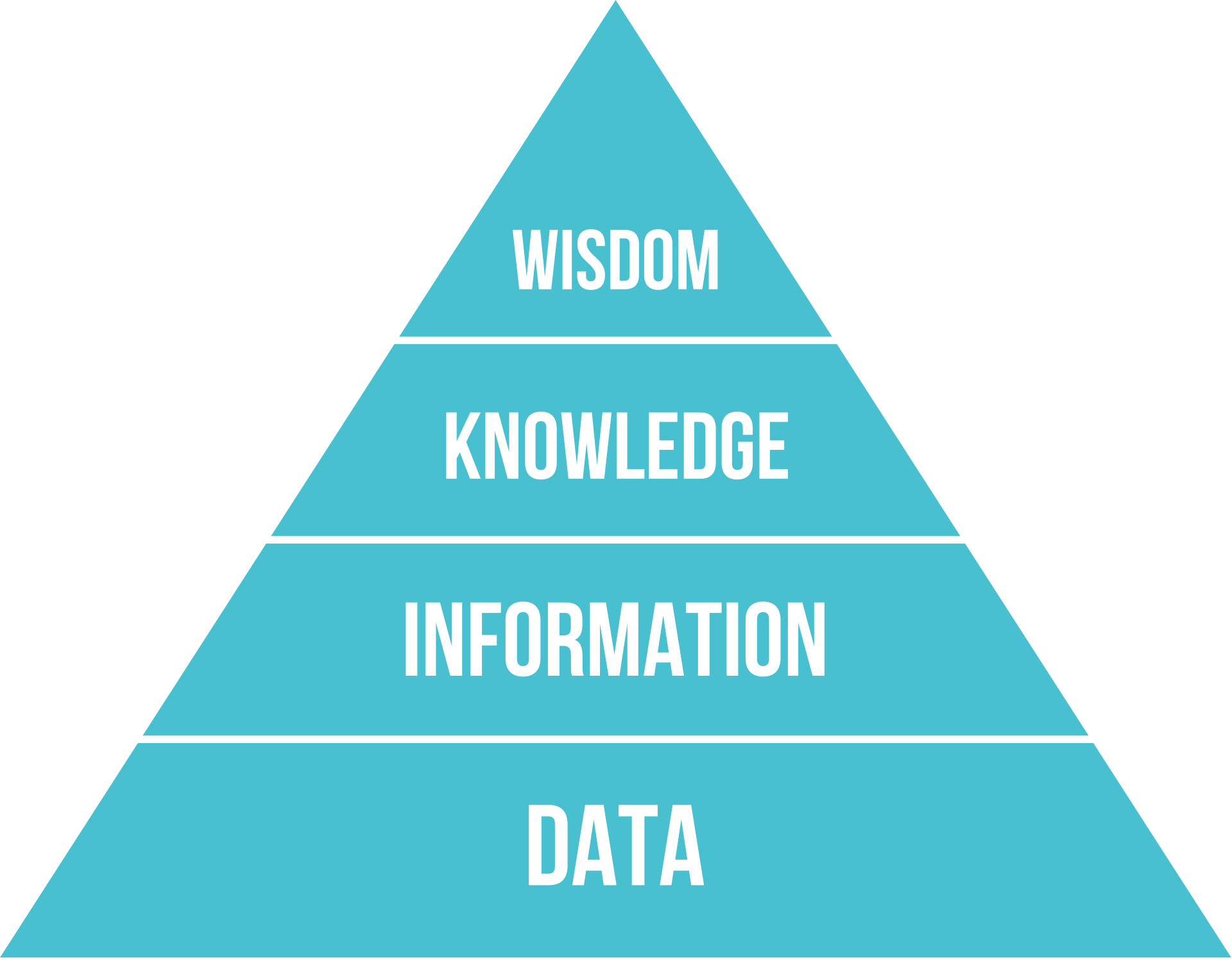
So what has changed in the twenty years I’ve been in this field. Well, a lot has changed — and a lot has not. In my last two blogs I’ve discussed the DIKW pyramid and written about how it should be expected that migration through the layers can be expected to take between ten and twenty years.

When we started in 2002, the majority of jurisdictions were still mired in the tail end of the “data” era — having data entry to enter documents into mainframe systems. Other than that, there was little automation. A number of jurisdictions were starting to move forward into the “information” era. There were two distinctly different approaches being taken. Many jurisdiction, as California had done before us, were taking a half-step into the new era using office productivity tools. The reason I consider this a half-step is because, while clearly a more modern approach than data entry into a mainframe, the step did little to prepare for the steps to come — being able to add layers of automation to increase the speed, volume, and efficiency of processing legislation. This was the lesson California had learned with their earlier project, and others have learned since — that without a robust semantic information model, you just can’t build robust automation tools. Many jurisdictions did understand this and were working towards a full step using XML-based tools. Although XML tools at the time were decidedly first generation, the benefits that automation promised outweighed the risks of being an early adopter.

So where are we today? While twenty years ago, most jurisdictions were at the end of the “data” era and start of the “information” era, there has been considerable, if slow, progress. Today most jurisdictions are either somewhere between the midpoint of the “information” era (mostly the office productivity approach) and into the early stages of the “knowledge” era (with the XML approach). Many of the systems deployed in the mid-2000s are now starting to age out and jurisdictions are looking to replace them with systems that can meet the modern demands of the 2020s.

As for Xcential, over the last few years we’ve been progressing from a consulting company to a product company — where we rely on third-party integrators to do implementations. This way we can leverage our 20 years of experience far more effectively. We still do our own implementations, when it makes sense, but we now offer LegisPro as a product that can be implemented by one of our partner companies, by a local integrator, or even by a jurisdiction’s own internal development team. Xcential today is very different from what it was 20 years ago, and our growth over the past year or so has been amazing — and for me quite exhausting.

It will be interesting to see where we are in another twenty years — although I may have retired by then. (most people roll their eyes at this point suggesting they think I’ll never want to retire)

Standard
Process, technology, Track Changes

Moving on Up to Document Synthesis

In my last blog, I discussed the DIKW pyramid and how the CAD world has advanced through the layers while the legal profession was going much slower. I mentioned that design synthesis was my boss Jerry’s favorite topic. We would spend hours at his desk in the evening while he described his vision for design synthesis — which would become the norm in just a few years.

Jerry’s definition of design (or document) synthesis was quite simple — it was the processing of the information found in one document to produce or update another document where that processing was not simple translation. In the world of electronic design, this meant writing a document that described the intended behavior of a circuit and then having a program that would create a manufacturable design using transistors, capacitors, resistors, etc. from the behavioral description. In the software world, we’ve been using this same process for years, writing software in a high-level language and then compiling that description into machine code or bytecode. For hardware design, this was a huge change — moving away from the visual representation of a schematic to a language-based representation similar to a programming language.

In the field of legal informatics, we already see a lot of processes that touch on Jerry’s definition of document synthesis. Twenty years ago, it was seeing how automatable legislation could be, but wasn’t, that convinced me that this field was ready for my skills.

So what processing do we have that meets this definition of document synthesis:

  • In-context amending is the most obvious process. Being able to process changes recorded in a marked up proposed version of a bill to extract and produce a separate amending document
  • Automated engrossing is the opposite process — taking the amending instructions found in one document to automatically update the target document.
  • Code compilation or statute consolidation is another very similar process, applying amending language found in the language of a newly enacted law to update pre-existing law.
  • Bill synthesis is a new field we’ve been exploring, allowing categorized changes to the law to be made in context and then using those changes and related metadata to produce bills shaped by the categorization metadata provided.
  • Automated production of supporting documents from legislation or regulations. This includes producing documents such as proclamations which largely reflect the information found within newly enacted laws. As sections or regulations come into effect, proclamations are automatically published enumerating those changes.

In the CAD world, the move to design synthesis required letting go of the visually rich but semantically poor schematic in favor of language-based techniques. Initially there was a lot of resistance to the idea that there would no longer be a schematic. While at University, I had worked as a draftsman and even my dad had started his career as a draftsman, so even I had a bit of a problem with that. But the benefits of having a rich semantic representation that could be processed quickly outweighed the loss of the schematic.

Now, the legislative field is wrestling with the same dilemma — separating the visual presentation of the law, whether on paper or in a PDF, from the semantic meaning found within it. Just as with CAD, it’s a necessary step. The ability to process the information automatically dramatically increases the speed, accuracy, and volume of documents that can be processed — allowing information to be produced and delivered in a timely manner. In our society where instant delivery has become the norm, this is now a requirement.

Standard
Process, technology, Uncategorized

The Knowledge Pyramid

At the very start of my career at the Boeing Company, my boss Jerry introduced the Knowledge Pyramid the DIKW Pyramid to me one evening. I had an insatiable thirst for learning and he would spend hours introducing me to ideas he thought I could benefit from. To me, this was a profound bit of learning that would somewhat shape my career.

At the time, I was working in CAD support, introducing automation technologies to the various engineering project’s around the Boeing Aerospace division. The new CAD tools were running on expensive engineering workstations and were replacing largely homegrown minicomputer software from the 1970’s.

Jerry explained to me that the legacy software, largely batch tools, that crunched data manually input from drawings represented the data layer. The CAD drawings our tools produced actually represented a digital representation of the designs with sufficient information for both detailed analysis and manufacturing. It would take a generation of new technologies to advance from one layer to the next in the DIKW pyramid — with each generation lasting from ten to twenty years. His interest was in accelerating that pace and so we studied, as part of our R&D budget, artificial intelligence, expert systems, language-based design techniques, and design synthesis.

While data was all about crunching numbers, information was all about understanding the meaning of the data. Knowledge came from being able to use the information to synthesize (Jerry’s favorite topic) new information and to gain understanding. And finally, wisdom came from being able to work predictively based on that understanding.

When I was introduced to legal informatics in the year 2000, it was a bit of a time warp to me. While the CAD world had advanced considerably and even design synthesis was now the norm, legal informatics was stuck in neutral in the data processing world of the late 1970s and early 1980s. Mainframe tools, green screen editors, and data entry was still the norm. It was seeing this that gave me the impetus to work to advance the legal field. The journey I had just taken in the CAD world of the prior 15 years was yet to be taken in the legal field. The transition into information processing was to start with the migration to XML — replacing the crude formatting oriented markup used in the mainframe tools with modern semantic markup that provided for a much better understanding of the meaning of the text.

To say the migration to the future has gone slowly would be an understatement. There are many reasons why this has happened:

  • The legacy base of laws have to be carried along — unchanged in virtually every way. This would be like asking Boeing to advance their design tools while at the same time requiring that every other aircraft design ever produced by the company in the prior century also be supported. For law, it a necessary constraint, but also a tremendous burden.
  • The processes of law are bound by hard-to-change traditions, sometimes enshrined by the constitution of that jurisdiction. This means the tools must adapt more to the existing process than the process can adapt to the tools. Not only does this constraint require incredibly adaptable tools, it is very costly and dampers the progress that can be made.
  • The legal profession, by and large, is not technology driven and their is little vision into what can be. The pressure to keep things as they are is very strong. In the commercial world, companies simply have to advance or they won’t be competitive and will die. Jurisdictions aren’t in competition with one another and so the need to change is somewhat absent.

For advancements to come their needs to be pressure to change. Some of this does come naturally — the hardware the old tools run on won’t last forever. New legislators entering into their political careers will quickly be frustrated by the archaic paper-inspired approach to automation they find. For instance, viewing a PDF on a smartphone is not the best user experience. It is that smartphone generation that will drive the need to change.

Over the next few blogs, I’m going to explore where legal informatics is on the DIKW pyramid and what advancements on the horizon will move us up to higher levels. I’ll also take a look at new software technologies that point the way to the future — for better or worse.

Standard
Uncategorized

I’m Back!!!

After a long hiatus away from my blog, I decided to reinstate it and get back to regular blogging.

There are going to be a few changes. While the subject stays the same, I’m returning this blog to its original intent — a personal blog about the technologies, tools, processes I encounter and the many events I participate it. It’s going to be less about Xcential and LegisPro and more about my experiences in the field of legislative technology.

It’s not that Xcential and LegisPro don’t remain an important part of my life — they remain the central focus. However, as my blog started to become more of a marketing tool and less of a personal blog, my interest started to wane.

Another change is that I’m going to focus on simpler more frequent blogs. They will cover a range of topics:

  • Observations and discoveries about legislative technologies
  • Experiences implementing Akoma Ntoso and other XML document models around the world
  • Modern technologies I learn and apply as part of my job
  • Software development processes and practices
  • Software tools and platforms
  • Events relating to legislative technology

If there is something you think I should cover, let me know in the comments.

Standard
Akoma Ntoso, HTML5, LegisPro Sunrise, Standards, technology, Track Changes, Uncategorized, W3C

LegisPro Sunrise!!!

LegisPro Sunrise is almost done!. It has taken longer than we had hoped it would, but we are finally getting ready to begin limited distribution of LegisPro Sunrise, our productised implementation of our LegisPro drafting and amending tools for legislation and regulations. If you are interested in participating  in our early release program, please contact us at info@xcential.com. If you already signed up, we will be contacting you shortly.

LegisPro Sunrise is a desktop implementation of our web-based drafting and amending products. It uses Electron from GitHub, built from Google’s Chromium project, to bundle all the features we offer, both the client and server sides into a single easy-to-manage desktop application with an installer having auto-update facilities. Right now, the Windows platform is supported, but MacOS and Linux support will be added if the demand is there. You may have already used other Electron applications – Slack, Microsoft’s Visual Studio Code, WordPress, some editions of Skype, and hundreds of other applications now use this innovative new application framework.

Other versions

LegisProAIn addition to the Sunrise edition, we offer LegisPro in customised FastTrack implementations of the LegisPro product or as fully bespoke Enterprise implementations where the individual components can be mixed and matched in many different ways.

Akoma Ntoso model

AkomaNtoso

LegisPro Sunrise comes with a default Akoma Ntoso-based document model that implements the basic constructs seen in many parliaments and legislatures around the world that derive from the Westminster parliamentary traditions.

Document models implementing other parliamentary or regulatory traditions such as those found in many of the U.S. states, in Europe, and in other parts of the world can also be developed using Akoma Ntoso, USLM, or any other well-designed XML legislative schema.

Drafting & Amending

Our focus is on the drafting and amending aspects of the parliamentary process. By taking a digital-first approach to the process, we are able to offer many innovative features that improve and automate the process. Included out of the box is what we call amendments in context where amendment documents are extracted from changes recorded in a target document. Other features can be added through an extensive plugin mechanism.

Basic features

Ease-of-use

While offering sophisticated drafting capabilities for legislative and regulatory documents, LegisPro Sunrise is designed to provide the familiarity and ease-of-use of a word processor. Where it differs is in what happens under the covers. Rather than drafting using a general purpose document model and using styles and formatting to try to capture the semantics, we directly capture the semantic structure of the document in the XML. But don’t worry, as a drafter, you don’t need to know about the underlying XML – that is something for the software developers to worry about.

Templates
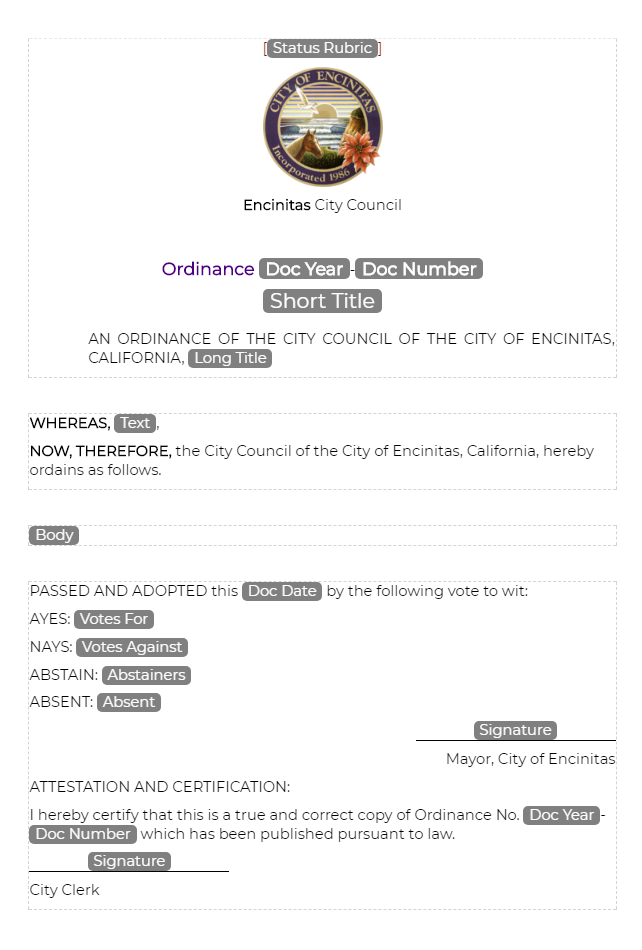
TemplateTemplates allow the boilerplate structure of a document to be instantiated when creating a new document. Out-of-the-box, we are providing generic templates for bills, acts, amendments, amendment lists, and a few other document types.

In addition to document templates, component templates can be specified or are synthesized when necessary to be used as parts when constructing a document.

For both document and component templates, placeholders are used to highlight area where text needs to be provided.

Upload/Download

As a result to our digital-first focus, we manage legislation as information rather than as paper. This distinction is important – the information is held in XML repositories (a form of a database) where we can query, extract, and update provisions at any level of granularity, not just at the document level. However, to allow for the migration from a paper-oriented to a digital first world, we do provide upload and download facilities.

Undo/Redo

undoRedoAs with any good document editor, unlimited undo and redo is supported – going back to the start of the editing session.

Auto-Recovery

Should something go wrong during an editing session and the editor closes, an auto-recovery feature is provided to restore your document to the state the document was at, or close to it, when the editor closed.

Contextual Insert Lists

insertLists

We provide a directed or “correct-by-construction” approach to drafting. What this means is that the edit commands are driven by an underlying document model that is defined to enforce the drafting conventions. Wherever the cursor is in the document, or whatever is selected, the editor knows what can be done and offers lists of available documents components that can either be inserted at the cursor or around the current selection.

Hierarchy
hierarchy

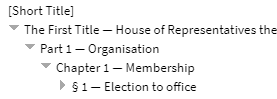
Document hierarchies form an important part of any legislative or regulatory document. Sometimes the hierarchy is rigid and sometimes it can be quite flexible, but either way, we can support it. The Sunrise edition supports the hierarchy Title > Part > Chapter > Article > Section > Subsection > Paragraph > Subparagraph out of the box, where any level is optional. In addition, we provide support for cross headings which act as dividers rather than hierarchy in the document. Customised versions of LegisPro can support whatever hierarchy you need — to any degree of enforcement. A configurable promote/demote mechanism allows any level to be morphed into other levels up and down the hierarchy.

Large document support

Rule-making documents can be very large, particular when we are talking about codes. LegisPro supports large documents in a number of ways. First, the architecture is designed to take advantage of the inherent scalability of modern web browsing technology. Second, we support the portion mechanism of Akoma Ntoso to allow portions of documents, at any provision level, to be edited alone. A hierarchical locking mechanism allows different portions to be edited by different people simultaneously.

Spelling Checker
checkSpelling

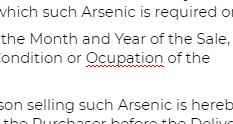
Checking spelling is an important part of any document editor and we have a solution – working with a third-party service we have tightly integrated with in order to give a rich and comprehensive solution. Familiar red underline markers show potential misspellings. A context menu provides alternative spellings or you can add the word to a custom dictionary.

Tagging support

Tagging

Beyond basic drafting, tagging of people, places, or things referred to in the document is something for which we have found a surprising amount of interest. Akoma Ntoso provides rich support for ontologies and we build upon this to allow numerous items to be tagged. In our FastTrack and Enterprise solutions we also offer auto-tagging technologies to go with the manual tagging capabilities of LegisPro sunrise.

Document Bar

docbar

The document bar at the top of the application provides access to a number of facilities of the editor including undo/redo, selectable breadcrumbs showing your location in the document, and various mode indicators which reflect the current editing state of the editor.

Command Ribbons and Context Menus

menuRibbons

Command ribbons and context menus are how you access the various commands available in the editor. Some of the ribbons and menus are dynamic and change to reflect the location the cursor or selection is at in the editor. These dynamic elements show the insert lists and any editable attributes. Of course, there is also an extensive set of keyboard shortcuts for many commonly used commands. It has been our goal to ensure that the majority of the commonly used documenting tasks can be accomplished from the keyboard alone.

Sidebar
SidebarA sidebar along the left side of the application provides access to the major components which make up LegisPro Sunrise. It is here that you can switch among documents, access on-board services such as the resolver and amendment generator, outboard services such as the document repository, and where the primary settings are managed.

Side Panels
sidePanel

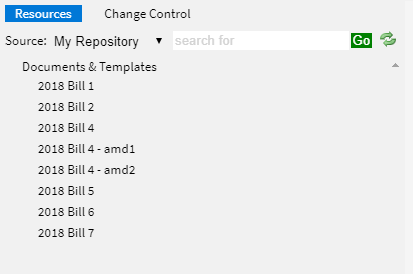
Also on the left side are additional configurable side panels which provide additional views needed for drafting. The Resources view is where you look up documents, work with the hierarchy of the document being edited, and view provisions of other documents. The Change Control view allows the change sets defined by the advanced change control capabilities (described below) to be configured. Other panels can be added as needed.

Advanced features

In addition to the rich capabilities offered for basic  document editing, we provide a number of advanced features as well.

Document Management

Document management allows documents to be stored in an XML document repository. The advantage of storing documents in an XML repository rather than in a simple file share or traditional content management system is that it allows us to granularise the provisions within the documents and use them as true reference-able information – this is a key part of moving away from paper document-centric thinking to a modern digital first mindset. An import/export mechanism is provided to add external documents to the repository or get copies out. For LegisPro Sunrise we use the eXist-db XML database, but we can also provide customised implementation using other repositories.

Resolver

Our document management solution is built on the FRBR-based metadata defined by Akoma Ntoso and uses a configurable URI-based resolver technology to make human readable and permanent URIs into actual URLs pointing to locations within the XML repository or even to other data sources available on the Web.

Page & Line numbering
pagination

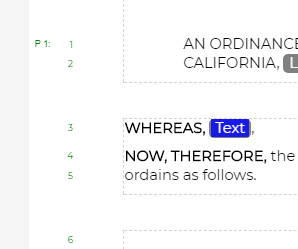
There are two ways to record where amendments are to be applied – either logically by identifying the provision or physically by page and line numbers. Most jurisdictions use one or the other, and sometimes even both. The tricky part has always been the page and line numbers. While modern word processors usually offer page and line numbers, they are dynamic and change as the document is edited. This makes this feature of limited use in an amending system. What is preferred is static page and line numbers that reflect the document at the last point it was published for use in a committee or chamber. We accomplish this approach using a back-annotation technology within the publishing service. LegisPro Sunrise also offers a page and line numbering feature that can be run without the publishing service. Page and line numbers can be display in the left or right margin in inline, depending on preference.

Amendment Generation

One of the real benefits of a digital first solution is the many tasks that can be automated – not by simply computerising the way things have always been done, but by rethinking the approach altogether. Amending is one such area. LegisPro Sunrise incorporates an onboard service to automatically generate amendment documents from changes recorded in the target document. Using tracked changes, the document hierarchy, and annotated page and line numbers, we are able to very precisely record proposed changes as amendments. Of course, the amendment generator works with the change sets to allow different amendment sets to be generated by specifying the named set of changes.

Plugin Support
plugins

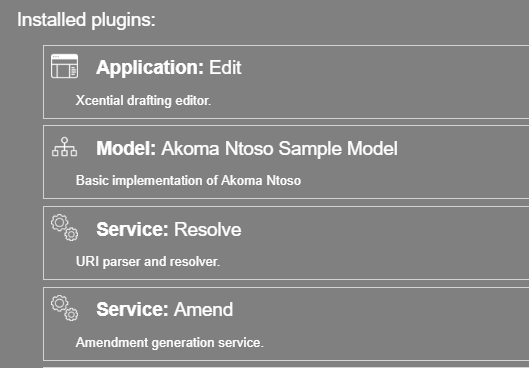
LegisPro Sunrise is not the first incarnation of our LegisPro offering. We’ve been using the underlying technologies and precursors to those technologies for years with many different customers. One thing we have learned is that there is a vast variation in needs from one customer to another. In fact, even individual customers sometime require very different variations of the same basic system to automate different tasks within their organisation. To that end, we’ve developed a powerful plug-in approach which allows capabilities to be added as necessary without burdening the core editor with a huge range of features with limited applicability. The plugin architecture allows onboard and outboard services to be added, individual commands, menus, menu items, side panels, mode indicators, JavaScript libraries, and text string libraries to be added. In the long term, we’re planning to foster a plugin development community.

Proprietary or Open Source?

There are two questions that always come up relating to our position on standards and open source software:

  1. Is it based on standards? Yes, absolutely – almost to a fault. We adhere to standards whenever and however we can. The model built into LegisPro Sunrise is based on the Akoma Ntoso standard that has been developed over the past few years by the OASIS LegalDocML technical committee. I have been a continual part of that effort since the very beginning. But beyond that, we always choose standards-based technologies for inclusion in our technology stack. This includes XML, XSLT, XQuery, CSS, HTML5, ECMAScript 2015, among others.
  2. Is it open source?
    • If you mean, is it free, then the answer is only yes for evaluation, educational, and non-production uses. That’s what the Sunrise edition is all about. However, we must fund the operation of our company somehow and as we don’t sell advertising or customer profiles to anyone, we do charge for production use of our software. Please contact us at info@xcential.com or visit our website at xcential.com for further information on the products and services we offer.
    • If you mean, is the source code available, then the answer is also yes – but only to paying customers under a maintenance contract. We provide unfettered access to our GitHub repository to all our customers.
    • Finally, if you’re asking about the software we built upon, the answer is again yes, with a few exceptions where we chose a best-of-breed commercial alternative over any open source option we had. The core LegisPro Sunrise application is entirely built upon open source technologies – it is only in external services where we sometimes rely up commercial third-party applications.


1200px-HTML5_logo_and_wordmark.svg         CSS            JavaScript-logo

nodejs-new-pantone-black
AngularJS_logo.svg
electron
What does it cost?

As I already alluded to, we are making LegisPro Sunrise available to potential customers and partners, academic institutions, and other select individuals or organisations for free – so long as it’s not used for production use — including drafting, amending, or compiling legislation, regulations, or other forms of rule-making. If you would like a production system, either a FastTrack or Enterprise edition, please contact us at info@xcential.com.

Coming Soon
Book

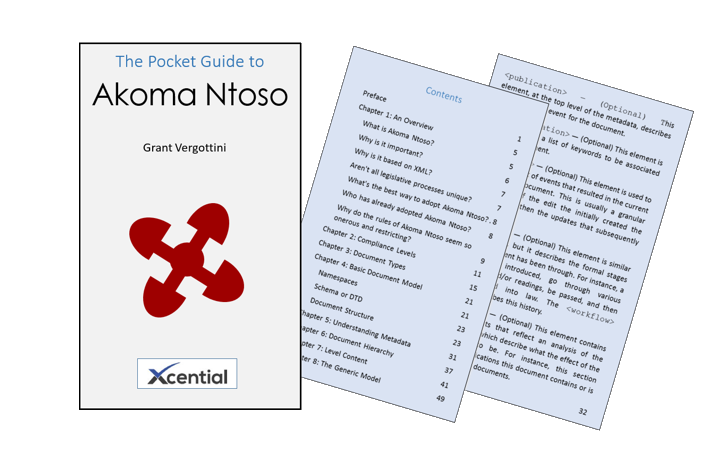
I will soon also be providing a pocket handbook on Akoma Ntoso. As a member of the OASIS LegalDocML Technical Committee (TC) that has standardised Akoma Ntoso, it has been important to get the handbook reviewed for accuracy by the other TC members. We are almost done with that process. Once the final edits are made, I will provide information on how you can obtain your own copy.


Standard
Akoma Ntoso, How To, Standards, Uncategorized

Using the <hcontainer> Element Properly

When I started my blog five years ago, I said would try not to get too technical. Overall, I’ve stuck to that. However, with Akoma Ntoso now essentially standardised, I think it is time to start covering some areas of it in a little more technical detail. So, from time to time, I’m going to delve into a little technical mumbo jumbo to cover some subjects that come up frequently.

In this blog, I want to cover the proper use of the <hcontainer> element. Akoma Ntoso has rich support for hierarchical documents as legal documents tend to be strongly hierarchical. Consequently, there is a large selection of element tags to choose from. During the standardisation effort, we tried to identify as many hierarchical constructs we could find in legal documents, but it was impossible to identify every single construct in every single jurisdiction around the world. Indeed, we sometimes decided that some hierarchical levels were just too unique to a specific jurisdiction to warrant inclusion in a standard intended for worldwide adoption. Sometimes, having too many tags is worse than having not enough, especially when there is a way to handle the outlier cases.

So, what is the proper way to use the <hcontainer>? The <hcontainer>, or hierarchical container, is a generic element intended to be use to invent and element that is needed but not found among the existing Akoma Ntoso hierarchical elements. The @name attribute is used to define the name of the new element you’re inventing. For this reason, the value of the @name should be consistent with the element naming convention of Akoma Ntoso:

  • The name should be lowerCamelCase.
  • The name should be in British English rather than another variant of English or another language. (Yes, we have two exceptions to this rule in Akoma Ntoso, one because the English form didn’t exist and one because we didn’t notice a spelling variation)
  • The name should not already exist in Akoma Ntoso.

One question that comes up from time to time is whether an <hcontainer> can be used to define an element that already exists, but in another language. For instance, could I define <hcontainer name=”artículo”> to define a Spanish article rather than use <article>? While there is nothing that prevents this practice, that would not be in the spirit of Akoma Ntoso. A large part of the motivation of Akoma Ntoso is to promote both data and tool interoperability. Localising the element tags completely undermines Akoma Ntoso as a standard. You might as well simply use your own schema. Please consider the consumers of your data when facing this question, not just the producers.

[We use an alternate mechanism, provided by our tools, to present a localized term to the user rather than the element name.]

Another question I’ve have been has to do with hierarchical levels that might not have a formalised name at all. I’ve come across this a number of times, in a number of ways. First, it’s often an issue of very old documents where the document hierarchy was either not formalised or not explicitly stated and conversion involves some degree of guessing. Second, there are sometimes lower levels, for instance, below the section level, where the level names have simply not been formalised or are used inconsistently. Third, I’ve come across a case where the upper levels, above the section, were not named in because the corresponding concepts didn’t really exist in the language used in that jurisdiction. For these cases, we use the <level> element.

The <hcontainer> is a very useful element in Akoma Ntoso. It’s a key part of the design of the schema that allows it to be easily adapted to any legislative tradition. However, it should be used judiciously — only when there isn’t already an alternative.


Standard
Akoma Ntoso, LegisPro Sunrise, LEX Summer School, Standards

LEX Summer School 2017

For the past two weeks I’ve been in Italy attending the LEX Summer School and Akoma Ntoso Developer’s Workshop at the Ravenna campus of the University of Bologna. This is my eighth summer school in Ravenna and my tenth overall LEX Summer School including the two U.S. editions. It’s always one of the highlights of my year.

With Akoma Ntoso as a standard now all but completed, a product about to debut, and a couple Akoma Ntoso projects to our name, I thought it would be a good time to reflect how far we have come. Bill Gates once said “Most people overestimate what they can do in one year and underestimate what they can do in 10 years.” This is a case of that. At times, the progress is frustratingly slow and arduous, but when you look back how far we’ve come in 8 years, we’ve made pretty good progress.

When I arrived at the first summer school I attended back in 2010, I had never heard of Akoma Ntoso — let alone learned how to pronounce it. A lot of the discussion still revolved around whether using purpose-built XML tools or re-purposing office productivity software was the way to go. Did the world really need Akoma Ntoso or was Open Office’s XML formats adequate? What about Microsoft’s Office Open XML? Was it an alternative?

We don’t discuss that anymore — the answer is obvious. As Luca Cervone commented to me, all of a sudden the other approaches look so old-fashioned. In fact, the presentations that did still use that approach were apologetic that their decisions dated back to the early 2000s when the answer was less clear.

What we now see is the value of putting data first and paper second. Making paper take the back seat in order to take advantage of the inherent power of treating legislation as data is now clearly the way to go. We see this in all the innovative capabilities that were on display — from the advanced amending tools we’ve worked with the UK and Scottish Parliaments to develop, the rich ontology support tools being developed in several projects, to the various comparison and analysis capabilities that were on show. XML enables all of these capabilities, in ways that other approaches simply cannot.

Another change in the eight years is the extent to which Akoma Ntoso has been embraced, particularly in Europe:

  • In April of this year, the Chief Executive Board of the United Nations approved the use of Akoma Ntoso as the documentation standard throughout the entire system after a detailed analysis. (Akoma Ntoso began as a project of the UN Department of Economic and Social Affairs (UN/DESA) a decade ago).
  • Numerous projects at both the European Parliament and European Commission are now based on Akoma Ntoso, although perhaps in a bit of a disjoint manner.
  • The project I’ve devoted a lot of my life to over the past two years at the U.K. and Scottish Parliaments is committed to Akoma Ntoso. You can watch a video of an early version here.
  • The Italian Senate is adopting Akoma Ntoso to some extent, and the Italian Chamber of Deputies are considering following suit.
  • There are projects underway in Switzerland and South America to adopt Akoma Ntoso.
  • Even the U.S. House of Representatives has a prior commitment to support Akoma Ntoso in some way.

This is all very good progress and much more is simmering in the background.

One of my goals at this LEX Summer School was to start laying the seeds for an open framework API that would allow interoperable plugins to be developed that work with all Akoma Ntoso-based platforms. Here, Luca surprised me by showing the new open source Akomando toolkit. This is a JavaScript toolkit, to be made available via NPM, GitHub, and other means shortly, that will provide the basic utilities one needs to easily process XML. As the LIME editor and Xcential’s LegisPro are largely technologically aligned on modern and open web technologies, this toolkit is a natural fit for both applications. I think this is a very exciting development and one we plan to take advantage of as soon as possible.

So, all in all, not bad. Now it’s time to start building on that momentum. We have lots of ideas percolating that will be revealed in the months to come. I’m looking forward to doing another retrospective at the ten year mark.

Standard
Akoma Ntoso, HTML5, LegisPro Sunrise, LEX Summer School, Standards, technology, Track Changes

The Sun is Rising on Akoma Ntoso — and LegisPro too!

Two great news piece of news this week! First, the documentation for Akoma Ntoso has now been officially released by OASIS. Second, we’re announcing the latest version of  our LegisPro drafting platform for Akoma Ntoso, codenamed “Sunrise”.

After several years of hard work, we’ve made a giant step towards our goal of setting an international XML standard for legal documents. You can find the documents at the OASIS LegalDocML website. A special thanks to Monica Palmirani and Fabio Vitali at the University of Bologna for their leadership in this endeavour.

legispro250Later this week, Xcential will be announcing and showing the latest version of “Sunrise” version of LegisPro, at both NALIT in Annapolis, Maryland and at the LEX Summer School in Ravenna, Italy. This new version represents a long-planned change to Xcential’s business model. While we have a thriving enterprise business, we’re now focusing on also providing more affordable solutions for smaller governments.

Part of our plan is to foster an open community of providers around the Akoma Ntoso standard for legislative XML. With Akoma Ntoso now in place as a standard, we’re looking for ways to provide open interfaces such that cooperative tools and technologies can be developed. One of my goals at this years summer school in Ravenna is to begin outlining the open APIs that will enable this vision.

LegisPro

The new edition of LegisPro will be all about providing the very best options:

  1.  It will provide a word processing like drafting capability your drafters demand — along with the real capabilities you need:
    • We’re not talking about merely providing a way to style a word processing document to look like legislation.
    • We’re talking about providing easy ways to define the constructs you need for your legislative traditions, such as–
      • a configurable hierarchy,
      • configurable tagging of important information,
      • configurable numbering rules,
      • configurable metadata,
      • oh, and configurable styles too.
    • We’re talking about truly understanding your amending traditions and providing the mechanisms to support them, such as–
      • configurable track changes, because we understand that a word processor’s track changes are not enough,
      • as-published page and line markers, because we understand your real need for page and line numbers and that a word processor’s page and line numbering is not that,
      • robust typography, because we know there’s a quite a difference between the casual correspondence a word processor is geared for and the precision demanded in documents that represent laws and regulations.
  2. It will be as capable as we can make it — for real-world use rather than just a good demo:
    • We’re not talking about trying to sell you a cobbled together suite of tools we built for other customers.
    • We’re talking about working with specialists in all the sub-fields of legal informatics to provide best-of-breed options that work with our tools.
    • We’re talking about making as many options available to you as we know there is no one-size-fits-all answer in this field.
    • We’re talking about an extensible architecture that will support on-board plug-ins as well as server-side web-services.
    • We’re talking about providing a platform of choices rather than a box of pieces.
  3. It will be as affordable as we can possibly make it:
    • We’re talking about developing technologies that have been designed to be easily configured to meet a wide variety of needs.
    • We’re talking about using a carefully chosen set of technologies to minimize both your upfront cost and downstream support challenges.
    • We’re talking about providing a range of purchasing options to meet your budgetary constraints as best we can.
    • We’re talking about finding a business model that allows us to remain profitable — and spreads the costs of developing the complex technologies required by this field as widely and fairly as possible.
  4. It is as future-proof as we can possibly make it:
    • We’re not talking about trying to sell you on a proprietary office suite.
    • We’re talking about using a carefully curated set of technologies that have been selected as they represent the future of application development — not the past — including:
      • GitHub’s Electron which allows us to provide both a desktop and a web-based option, (This is the same technology used by Slack, WordPress, Microsoft’s Visual Studio Code, and hundreds of other modern applications.)
      • Node.js which allows us to unify client-side and server-side application development with “isomorphic JavaScript,”
      • JavaScript 6 (ECMAScript 2015) which allows us to provide a truly modern, unified, and object-oriented programming environment,
      • Angular and other application frameworks that allow us to focus on the pieces and not how they will work together,
      • CSS3 and LESS that allows us to provide state-of-the-art styling technologies for the presentation of XML documents,
      • the entire XML technology stack that is critical for enabling an information-centric rather than document-centric system as is appropriate for the 21st century,
      • and, of course, using the Akoma Ntoso schema for legislative XML to provide the best model for sharing data, information, tools, and other technologies. It’s truly a platform to build an industry on.
  5. It is as open as we can possibly make it:
    • We’re not talking about merely using an API published by a vendor attempting to create a perception of openness by publishing an API with “open” in the name.
    • We’re talking about building on a full suite of open source tools and technologies coming from vendors such as Google, GitHub, and even Microsoft.
    • We’re talking about using non-proprietary protocols such as HTTP and WebDAV.
    • We’re talking about providing an open API to our tools that will also work with tools of other vendors that support Akoma Ntoso.
    • And, while we must continue to be a profitable product vendor, we will still provide the option of open access to our GitHub repositories to our customers and partners. (We’ll even accept pull requests)

Our goal is to be the very best vendor in the legislative and regulatory space, providing modern software that helps make government more efficient, more transparent and more responsive. We want to provide you with options that are affordable, capable, and planned for the future. We want to do whatever we can to allay your fears of vendor lock-in by supporting open standards, open APIs, and open technologies. We want to foster an Akoma Ntoso-based industry of cooperative tools and technologies as we know that doing so will be in the best interests of everyone — customers, product vendors, service providers, and the people who support them. As someone once told me many years ago, if you focus on making the pie as large as you can, the crumbs left on the knife will be plenty enough for you.

Either come by our table at NALIT in Annapolis or join us for the Akoma Ntoso Developer’s Conference in Ravenna at the conclusion of the LEX Summer School to learn more. If neither of these options will work for you, you can always learn more at Xcential.com or by sending email to info@xcential.com.

Standard