Akoma Ntoso, Process, Standards, technology, Transparency

Changing the way the world legislates. Together.

I got my start, like my father before me, as a draftsman. I worked for the Cleveland Switchboard Company drawing power distribution switchboards and panel boards while earning my engineering degree at university. That experience led to me getting a job at the Boeing Company supporting drafting tools as an electronics design engineer.

It was a pivotal time at Boeing, and indeed for the entire industry. When I started, we were supporting drafting tools which used computers to emulate drafting boards. But within a few years, drafting tools gave way to design tools. The reason was simple. Computers enabled a whole different way of thinking. It wasn’t just a matter of putting pencil to paper anymore. Design tools allowed you to use a computer to do the intellectual engineering work behind the schematics that would be produced. My focus shifted from schematic drawings to fault simulations – being able to identify the many ways a system might fail such that those failure modes would never happen (a skill Boeing seems to have lost of late).

The pace of change in legal informatics has been much slower — something that has been frustrating to me. The transformation I witnessed in electronic design today allows me to have a virtual supercomputer in my pocket. It’s time for legislation to make the same leap into the future.

We need to get beyond legislative drafting and rethink the process by which policy initiatives become legislation which ultimately become law. There’s much more to that process than just writing the text for the documents that become bills.

There are many stakeholders in the legislative process – constituents, special interests, politicians, government representatives, and even the lawyers that draft the legislation. Synthesizing all the information they provide into a bill draft is a complex process. This is something I’ve been thinking about for a very long time. In fact, it was realizing that XML was the best medium for transforming the legislative process, in a way like what I had experienced in electronics design, that led me to start Xcential.

We now have the tools, technologies, and the standards to make this transformation a reality. We have tools that allow the lawyers who draft legislation to focus on the intellectual process rather than the technical process of getting the formatting or wording right. We have tools that allow all the stakeholders to work together rather than individually. And we have technologies and standards that ensure the precise representation and handling of the law.

When I left Boeing, I took a job working at a design automation company to revolutionize how engineers work – something we called “concurrent design”. I was the product manager for the design management component at the very heart of that system. The company tagline reflected the vision: “Changing the way the world designs. Together.” It’s time for a such big vision in our field.

Standard
Lawsuit, Process, technology, Transparency

Transparent legislation should be easy to read — part II

I have some good news to share. After almost two years under the cloud of litigation regarding a challenge to one of our patent applications, we have reached a settlement that concludes the issue. The Patent Trials and Appeals Board (PTAB) ruled in our favor by denying the patent derivation claim made against us. This was on top of earlier rulings in our favor. What is more, both our patent applications have now been allowed.

While the terms of the settlement remain confidential, this has been a costly exercise for us. For me personally, this was very difficult. Not only did I have to defend my honor and integrity, but I have had to spend half of my personal life savings in the defense of Xcential – with no guarantees that I will ever be able to recoup that expense. Using my own savings for a lot of the legal bills was the only way to ensure that Xcential would be able to go on. This has certainly affected my life.

If there is something good to come out of this exercise, it is validation that we’re onto something very valuable.  With the litigation behind us and both patents in our pocket, we are now able to proceed forward with our plans to serve our markets – selectively, of course,

Over a decade ago, I wrote a blog questioning why federal bills are written the way they are. For someone experienced with state legislation, federal legislation is quite cryptic and difficult to understand. It turns out that the style of amending law found in federal legislation is the common form and can be found around the world. In the U.S. Congress, this style is known as cut and bite1 amending. With this style, individual word changes are spelled out in a narrative form. For example, here is a section from California Assembly Bill 2748 from the current session:

SECTION 1.  Section 21377.5 of the Water Code is amended to read:

21377.5.  (a) Notwithstanding Section 21377 of this code or Section 54954 of the Government Code or any other provision of law, the Board of Directors of the Tri-Dam Project, which is composed of the directors of the Oakdale Irrigation District and the South San Joaquin Irrigation District, may hold no more than four regular meetings annually at the a Tri-Dam Project offices. The Board of Directors of the Tri-Dam Project shall adopt a resolution that determines the location of the Tri-Dam Project offices. office that is located in Sonora, California, or Strawberry, California, or within 30 miles of either city.

(b) The notice and conduct of these meetings shall comply with the provisions of the Ralph M. Brown Act (Chapter 9 (commencing with Section 54950) of Part 1 of Division 2 of Title 5 of the Government Code).

You can clearly see what changes are being made. However, if written using cut and bite amending, this equivalent section would read something like:

SECTION 1.  Section 21377.5 of the Water Code is amended by:

(a) Deleting the sixth “the” and replacing it with “a”.

(b) After “Tri-Dam Project”, deleting to the end of the subsection and replacing withoffice that is located in Sonora, California, or Strawberry, California, or within 30 miles of either city.”

This very terse form of amendment gives no context for the change being made. The change in subsection (a) is completely meaningless without any context. What this all means is that a politician tasked with approving these changes must do a significant amount of work to understand what the changes are all about and why they are being made.

Back in 2013, I questioned why the form found most of the U.S. states including my state of California wasn’t used. As seen in the example above, the U.S. states use a different approach to amending – known as amending in full. In this style of amending, the entire section containing the change is restated and the change is shown (some of the time) as stricken and inserted text, as you would find with track changes in a word processor. This approach has the benefit of making the change much clearer by providing the complete context of the change. In California, this approach is mandated by the State Constitution as amended by Proposition 1-a of 1966. This proposition was overwhelmingly approved by the voters of California. The Speaker of the California Assembly at the time, Jesse Unruh, had pushed through this constitutional amendment to establish professional legislature less beholden to special interests that other pressures that were undermining the effectiveness of the legislature at the time. His reforms were quite sweeping. Among the many changes, one part of this initiative was to make legislation more transparent.

The specific provision that was added, Section 9 of Article IV of the California Constitution, reads:

“A statute shall embrace but one subject, which shall be expressed in its title. If a statute embraces a subject not expressed in its title, only the part not expressed is void. A statute may not be amended by reference to its title. A section of a statute may not be amended unless the section is re-enacted as amended.”

This section of the California Constitution contains two rules. The first is the single subject rule, which limits the scope of each statute. The second is the re-enactment rule, which mandates the amendment in full approach, requiring that each section amended by re-enacting the whole section (essentially a repeal of the prior section and enactment of a new amended section as a single action). Most U.S. states have these same rules or very similar rules. These two rules go together. One of the worries of the re-enactment rule is that, by opening an entire section for re-enactment, unwelcome amendments might be added as part of the political process of winning votes. The single-subject rule is a guard against that behavior.

At the time of my original blog, I learned that adopting these rules in Congress would be impossible. For one thing, the U.S. Code is less regular than state codes or revised statutes, especially in the non-positive titles, and that re-enacting an entire section would be quite complex and could cause other difficulties. Re-enactment rules require consistently bite-sized sections. In addition, the House’s equivalent of the single subject rule, the germaneness rule adopted in 1789, didn’t have quite the same effectiveness as the single subject rule of California. Apparently, the Senate’s equivalent rules, found in the Senate Standing Rule XVI and Rule XXII had even more limited applicability.

As a result, I proposed in my blog that amendments in context be used. With amendments in context, a proposed bill is drafted using the amendments in full style that U.S. states use, from which a cut and bite style bill is generated using automation. With this approach, you get the best of both worlds. The bill is drafted in a form that is easy to understand and easy to manage while the worries of unleashing this amending style are circumvented by retaining the existing amending style for parliamentary procedures. However, at the time, the technology just wasn’t available. Under contract to the Law Revision Counsel, Xcential was just beginning down the path of converting the U.S. Code to processable XML that could feed the automation tools. While we had tools to offer that could do amendments in context, we were constrained by our agreement with California as to how much of our technology could be reused – they had been worried we could inadvertently undermine the successes of Proposition 1-a by empowering the special interests with our technology.

Today, more than a decade later, much has changed. The U.S. Code is available in an XML format we designed and a new more modern LegisPro is available that is both web-based and much more powerful than what we had back then. But there have been other changes too. The Posey Rule has been adopted requiring that a comparative print be provided alongside all proposed law showing how the law will be affected. This comparative print is also generated by Xcential technology and alleviates much of the problem by allowing politicians to understand more easily what it is they are voting on. However, it leaves the complexity of drafting and managing the process of creating and managing the cut-and-bite amendments still to be addressed.

This problem isn’t limited to U.S. federal bills. It’s a common problem wherever cut and bite amending is employed, particularly in Commonwealth countrie or countries with Westminster based legislative traditions, even if the term cut and bite isn’t used.

At Xcential, we’re going to return to our core mission – to make government processes better through technology. Our goal is improved efficiency, increased accuracy, and most importantly, better transparency for the benefit of the citizens.

  1. The term cut and bite is also sometimes used to refer to the form of amending used to propose amendments to bills themselves. Another term for these types of bill amendments are page and line amendments as they usually are expressed as references to page and line numbers rather than to provisions. ↩︎
Standard
Lawsuit, technology, Track Changes, Transparency

Lawsuit Update and a Tale about Bicycles

In the past couple weeks, the first two court rulings have come out concerning our battle with the Akin Gump law firm. Both rulings have been in our favor. The first ruling denied Akin Gump’s motion to dismiss, instead allowing four of the five claims in our countersuit – with the judge calling them “plausible”. The second ruling denied Akin Gump’s attempt at a preliminary injunction to stop us from responding to actions from the U.S. Patent Office. The judge found that “there is not a substantial likelihood that (Akin Gump) will prevail,.” She then added “(T)o preclude Xcential from moving forward…would discourage invention, it would discourage innovation, it would discourage companies from investing their own resources to try to come up with workable solutions to commonly identified problems,.”

After reading the transcript, I have an interesting analogy to make. It is based on an analogy that the Akin Gump attorney chose to use – comparing our dispute to that of inventing a bicycle. While it’s not a perfect analogy, it is still a very good analogy.

Imagine you have an idea for a two-wheeled mode of transportation that will help you do your job more effectively. You discover that this idea is called a bicycle and that there are several bicycle manufacturers already – so you approach one to see if their product can do the job. While this company did not invent the bicycle, they specialize in making them and have been doing so for many years. This company only make bicycles. They are not the manufacturer of the commodity materials that make up a bicycle such as the metal tubing or even the tools that bend the tubes to make handlebars. While not a household name, they are very well known among bicycle enthusiasts around the world.

However, you discover that there is a problem. In the highly regulated world of bicycles (maybe automobiles would have been a better analogy), this bicycle maker doesn’t have a bicycle that conforms to your local regulatory market. You have a quick 30-minute call with the bicycle maker, and they say they’re familiar with the regulations in your market, but that making the changes your local regulations require and getting those changes certified is a costly business and is only done for customers willing to help foot the bill. You indicate that you’re still interested and accept their suggestion that they build a prototype, at no charge, of the bicycle that is suitable for your regulatory market. You send them a hand drawn map of the routes you want to ride the bicycle on so that they can understand the regulatory concerns that might apply.

With the suggestion of funding, the bicycle maker goes off starts building a demonstrable prototype of a modified bicycle model that conforms to your local regulatory requirements. As a potential customer for this localized version of the bicycle, you get limited updates from the salesperson you were working with to ensure that you’re still interested and to indicate that the prototype hasn’t been forgotten. He makes a point of buttering you up, as salespeople are wont to do. You never interact with the engineers building the prototype at all.

It turns out that the regulations require mudguards over the wheels and reflectors on the front and rear. In the process of attaching these parts, the engineers at the bicycle company come up with some nifty brackets for attaching the mudguards and reflectors to the bicycle frame in accordance with the regulatory requirements. While the mudguards and reflectors are commodities, the brackets used to attach them are novel, so the engineers apply for patent protection for these brackets. You play no role in the design or manufacture of these brackets.

When the bicycle maker brings their modified bicycle to your office to show you what can be done, you’re wowed by the result, but don’t really have the budget to help cover the cost of getting the changes certified. The bicycle company shelves the project without a paying customer.

Later on, while pondering whether to patent your idea for a bicycle, you come across the bicycle maker’s patent application. Without much of an understanding into the making of bicycles, you conflate the general idea for a bicycle (it was invented decades earlier and is prior art at this point), a bicycle that is adapted to your regulatory market (not something that is patentable), and the nifty brackets that hold the reflectors and mudguards on the frame and are necessary to achieve regulatory compliance in your local market (and that you played no part in designing or manufacturing – but are patentable).

Standard
technology, Track Changes, Transparency, Uncategorized

Xcential in Litigation with Akin Gump Law Firm

As many of you know by now, Xcential and I have been placed in an unfortunate position of having to deal with litigation with a large Washington D.C. lobbying firm, Akin Gump. We have been getting a lot of press, and I feel it is my duty to explain the situation as best I can.

Back in late 2018, Xcential was approached by an attorney at Akin Gump interested in applying our bill drafting and amending application, LegisPro, to improve the process of drafting and amending federal legislation. Initially, he was interested in using LegisPro to generate a bill amendment. This eventually evolved into an investigation into whether LegisPro could generate a federal amending bill from an in-context marked up copy of the law itself. The Akin Gump attorney expressed frustration at having to type, in narrative format, the proposed changes to a federal bill, and sought a simpler solution.

Amending law in context was a use case for LegisPro’s amendment generating capabilities that we had long anticipated. I had even written a blog exploring the idea of amendments-in-context in 2013 which got a lot of coverage on Chris Dorobeck’s podcast and at govloop. I have long made a habit of reporting on the developments in the Legal informatics industry and the work I do at my Legix.info blog including this blog post from April 2018 which describes LegisPro’s feature set at that time.

First a little explanation about how LegisPro is configured to work. As there is no universal way to draft and amend legislation, we must build a custom document model that configures LegisPro for each jurisdiction we work with. Legislation, particularly at the federal level, is complex so this is a substantial task. The customer usually pays for this effort. For the federal government, we did have document models for parts of LegisPro, but they were specific to different use cases and belonged to the federal government, not Xcential. We were not entitled to use these configurations, or any part of them, outside the federal government. This means that, out-of-the-box, LegisPro was not tailored for federal legislation in a way that we could share with Akin Gump. We would have to build a new custom document model to configure LegisPro to draft federal legislation for them.

Once the attorney had had an opportunity to try out a trial version of LegisPro using an account we had provided, we had a meeting during May of 2019. To provide clarity to the conversation as our terminology and his were different, I introduced the terms amending-in-full, cut-and-bite amendments, and amendments-in-context to the Akin Gump attorney. This is the terminology we use in the legal informatics industry to describe these concepts. Seeing the attorney’s enthusiasm towards addressing the problem and being convinced this was a true sales opportunity, I said I would find the time to build a small proof of concept to show how LegisPro’s existing cut-and-bite amendment generator would be configured to generate federal style amendments. I had previously arranged to have a partial conversion of a part of the U.S. Code done by a contractor to support Akin Gump’s trial usage of LegisPro. In the months that followed and using this U.S. Code data set, I set about configuring LegisPro to the task, much of it on my own personal time. Akin Gump did not cover the cost of any of this including my time or the contractor’s fees.

I flew to Washington D.C. for an August 29th, 2019 meeting in the attorney’s office to deliver the demonstration of a working application in person. He was duly impressed and kept exclaiming “Holy S###” over and over. We explained that this was just a proof of concept and that we could build out a complete system using a custom document model for federal legislation. He had already explained that the cost for a custom document model was probably out of reach for Akin Gump, so we should consider the implementation as an Xcential product rather than a custom application for Akin Gump. We considered this approach and our offer to implement a solution was a very small percentage of what the real cost would be. We would need to find many more customers on K Street to cover the development cost of a non-government federal document model. He had explained this approach would earn Xcential a “K Street parade,” a term we used to describe the potential project of building a federal document model to be sold on K Street

As it turns out, even our modest offer of about $1,000 to $2,000 per seat (depending on various choices) and a range of $50,000 to $175,000 for a custom document model and other services was too much for Akin Gump, and they walked away. Our 2019 pricing sheet clearly mentioned that the per seat prices did not include the cost for document conversion or configuration/customization and that a custom document model might be required for an additional fee. Furthermore, we had discussed the need for this custom work on several occasions. Our offer was more than fair as building these systems typically runs into the millions of dollars. Despite considerable costs to us in terms of my time, the use of a contractor, and travel to Washington D.C., we were never under any obligation to deliver anything to Akin Gump, and Akin Gump never paid us anything.

In the process of configuring LegisPro to generate federal amending bills, I came up with some implementation changes to the core product which we felt were novel. They built on a mechanism we had already built for a different project and for which we had separately applied for a patent a year earlier. We went ahead and filed for a patent for those changes, describing the overall processing model using a term I coined called “bill synthesis,” echoing my experience with logic synthesis earlier in my career from which I had drawn inspiration.

Two and a half years later, we learned that Akin Gump had filed a complaint to assume ownership of our patent application. This made no sense at all as our patent application is very implementation specific to LegisPro’s inner workings. The Akin Gump attorney involved had played no part in the design or coding of these details. What he had done was to describe his frustrations with the federal bill drafting use case to us – something we had long been aware of. He was simply asking us for a solution to a problem that was widely known in the industry and previously known to us.

When I got to see the assertions that Akin Gump makes in its court filings, I was astonished by their breadth. Rather than technical details, the assertions are all high-level ideas, insisting that an idea for an innovation the attorney had conceived of in the summer of 2018 is the “proverbial ‘holy grail’” to the legislative drafting industry. However, this innovative idea, as described in the complaint, is an application that closely resembles LegisPro as he would have experienced it during his trial usage in early 2019, including descriptions of key services and user interface features that have long existed.

What does not get any mention in Akin Gump’s filings are the details of our implementation for which we have based our patent claims — around document assembly and change sets. This is not surprising. The attorney is not a software developer and Akin Gump is not a software firm, it is a law firm. Neither he nor the firm have any qualifications in the realm of complex software development.

I can appreciate the attorney’s enthusiasm. When I came across the subject back in 2001, I was so enthusiastic that I started a company around it.

But for me, this is very hurtful. I worked hard, much of it on my own time over summer to build the proof of concept for Akin Gump. Yet I am portrayed in a most unflattering way. While I recall a cordial working arrangement throughout the effort, that is not how Akin Gump’s complaint reads. There is no appreciation for the complexity of writing or even configuring software to draft and amend legislation. The attorney forgets to mention that I succeeded in demonstrating a working application in the form of proof of concept on August 29th in his office. There is no understanding of the deep expertise that I brought to the table. The value of the time that I had spent on this project already was likely worth more than the amount we asked from Akin Gump to deliver a solution.

I wake up many nights angry at what this has come to. We work hard to make our customers happy and to do so at a very fair price. We are a small company, based in San Diego, and having to defend ourselves against the accusations of a wealthy law firm is a costly and frustrating undertaking that distracts from our mission.

What is ironic is that, by taking a litigation route to claim a patent, Akin Gump has all but closed off any likelihood of ever having the capability. There are few software firms in the world capable of creating such a system. In the U.S. I only know of a couple, none of which have the experience and products which Xcential can bring to bear. For this solution to ever see the light of day at the federal level, it is going to take a substantial effort, with many trusted parties working collaboratively.

I once had a boss who would often say “when all you have is a hammer, everything looks like a nail.” Just because you have something in your toolbox, you should choose wisely if using it is the right course of action. For a law firm, litigation is an easy tool to reach for. But is it the right tool?

Standard
Process, technology

Building an Agile Team

We’ve recently built our first true Agile development team. It’s been quite a learning experience, but now we’re seeing the results.

At Xcential, we have lots of waterfall process experience. Our backgrounds come from big waterfall companies like Boeing and Xerox. Over the years we’ve worked on very large projects in very traditional ways. In more recent years, we’ve also had a few Agile projects, largely initiated by customers, that have been good training grounds for us — for better or worse.

Like many companies, in recent years we’ve fallen victim to what the U.S. Department of Defense calls Agile BS — when you apply Agile terminology to your existing way of doing business. It’s a way to dilute Agile and turn it into nothing but a series of buzzwords. We’ve had sprints, standups, product owners, backlogs, and all the other bits of Agile — but we haven’t had the mindset that is necessary to make the Agile process work.

To build an Agile Team, we have needed to make a few key changes. First, we had assemble a team of developers who would gel together to become a performing team as fast as possible. Then, in order to overcome the inertia of the old way of doing things, we had to ensure that the team was trained to tackle the challenge in front of them. Finally, we have had to ensure that all the team members felt empowered to rise up and take ownership for their project.

An Agile team must be self-managing. This means that all the team members must feel the responsibility to deliver and have a commitment to do their part. Getting to that point has been a challenge — from getting management to let go and trust the team to getting the team members to step up and trust that their responsibilities are real.

I like to think of managing a team as being a game of chess. In a traditional arrangement, the managers are the back row while the developers and the interchangeable pawns in the front row — to be assigned here, there and everywhere.

In an Agile team, the roles are different. The team is self-managing. There is no front row and back row. Everyone has an important role in the team. This means that everyone should be challenged to step up to a bigger role than they would have had in a traditional team. While some team members are timid at first, having everyone feel empowered to play an important role is a key to the success of Agile.

We still have some challenges. Developers are still bouncing from one project to another. This discontinuity of effort shows as a reluctance to commit to the story points that will ultimately be necessary to complete the project in a timely way. It also distracts from our efforts to form team bonds. It’s hard to consider the team your home team when you’re feeling like a visitor to every team you work on.

Nonetheless, we’re starting to see real results from our prototype Agile team. Continuous integration procedures have been put in place ensuring a “done” product increment at the end of each sprint. For various reasons, delivery of these iterations to customers have not yet started, but this will be rectified at the end of the next sprint. We have peer reviews which are both improving the quality of the product with providing some degree of cross-training. The team’s velocity is improving, albeit at a slow rate. Over the next few sprints we will start integrating more and more with the other projects — and hopefully drawing them all into our new and more efficient way of building software.

Standard
Uncategorized

Mapping Amending Language to Akoma Ntoso Modifications

In my last blog, I talked about Xcential’s long history working with change management as it applies to legislation and my personal history working in the subject in other fields.

In this blog, I’m going to focus in on change management as it is used in Akoma Ntoso. I’m going to use, as my example, a piece of legislation from the California Legislature. As I implemented the drafting system used in Sacramento (long before Akoma Ntoso), I have a bit of a unique ability to understand how change management is practiced there.

First of all, we need to introduce some Akoma Ntoso terminology. In Akoma Ntoso, a change is known as a modification. There are two primary types of modifcations:

  1. Active modifications — modifications in which one document makes to another document.
  2. Passive modifications — modifications being proposed within the same document.

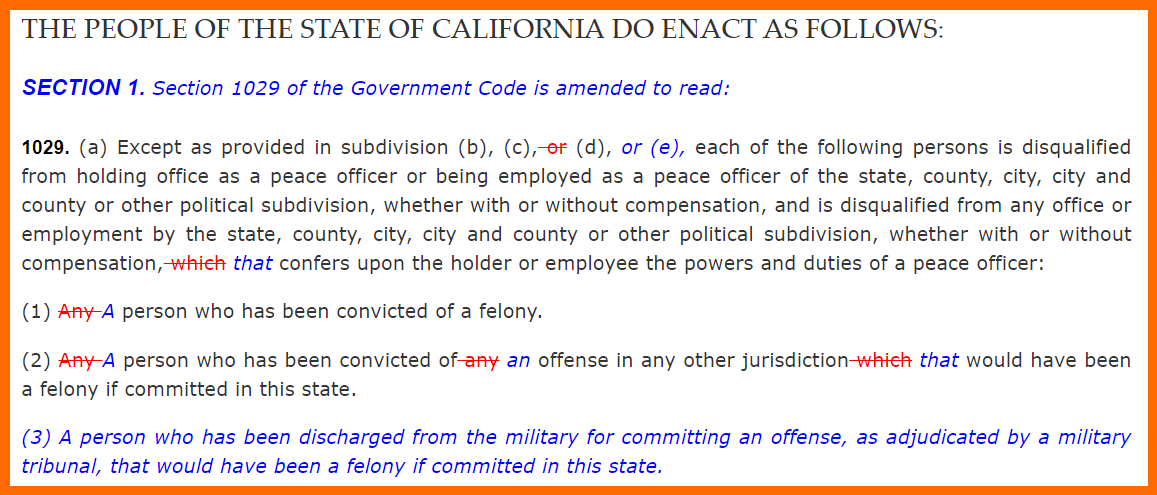
The snippet I am using for example is a cropped section from AB17 from the current session:

In California, many changes are shown using what they call redlining — or you may know as track changes. However, it would be a mistake to interpret them literally as you would in a word processor — a bit of the reason why it’s difficult to apply a word processor to the task of managing legislative changes.

In the snippet above, there are a number of things going on. Obviously, Section 1 of AB17 is amending Section 1029 of the Government Code. Because California, like most U.S. states, only allows their codes or statutes to be amended-in-full. The entire section must be restated with the amended language in the text. This is a transparency measure to make it more clear exactly how the law is being changed. The U.S. Congress does not have this requirement and Federal laws may use the cut-and-bite approach where changes can be hidden in simple word modifications.

Another thing I can tell right away is that this is an amended bill — it is not the bill as it was introduced. I will explain how I can tell this in a bit.

From a markup standpoint, there are three types of changes in this document. Only two of these three types are handled by Akoma Ntoso:

  1. As I already stated, this bill is amending the Government Code by replacing Section 1029 with new wording. This is an active change in Akoma Ntoso of type insertion.
  2. Less obvious, but Section 1 of AB17 is an addition to the bill as originally introduced. I can tell this because the first line of Section 1, known in California as the action line, is shown in italic (and in blue which is a convention I introduced). The oddity here is that while the section number and the action line are shown as an insertion, the quoted structure (an Akoma Ntoso term), is not shown as inserted. The addition of this section to the original bill is a passive change of type insertion.
  3. Within the text of the new proposed wording for Section 1029, you can also see various insertions and deletions. Here, you have to be very careful in interpreting the changes being shown. Because this is the first appearance of this amending section in a version of AB17, the insertions and deletions shown reflect proposed changes to the current wording of Section 1029. In this case, these changes are informational and are neither an active nor passive change. Had these changes been shown in a section of the bill that had already appeared in a previous version of AB17, these these changes would be showing proposed changes to the wording in the bill (not necessarily to the law) and they would be considered to be passive changes.

The rules are even more complex. Had section 1 been adding a section to the Government Code, then the quoted text being added would be shown as an insertion (but only in the first version of the bill that showed the addition). Even more complex, had the Section 1 been repealing a section of the Government Code, then the quoted text being repealed would be shown as a deletion (and would be omitted from subsequent versions of the bill). This last case is particularly confusing to the uninitiated because the passive modification of type insert is adding an active modification of type repeal. The redlining shows the insertion as an italic insertion of the action line while the repeal is being shown as a stricken deletion of the quoted structure.

The lesson here is that track changes, as we may have learned them in a word processor, aren’t as literal as they are in a word processor. There is a lot of subtle meaning encoded into the representation of changes shown in the document. Being able to control track changes in very complex ways is one of the challenges of building a system for managing legislative changes.

Standard
Uncategorized

Xcential is a Change Management Company

At Xcential, we typically describe ourselves as a legislative technology company. While that is correct, the true answer is more nuanced than that. We purposefully don’t solve problems that are mainstream and relatively easily solved by other off-the-shelf software. Instead, we say that we focus on drafting but, in saying that, we understate what we do. In practice, we focus on a very complex and high-value problem called change management — as it relates to legislation. Few people truly know how to solve this problem.

Twenty years ago, the founders of Xcential worked at an XML database company that was a subsidiary of Xerox. We started Xcential because we thought the legislation was one of the best applications for XML we had ever come across. It was the change management aspects that fascinated me, in particular. While my knowledge of legislation was based on high school civics class, I had a lot of experience in the field of change management.

At the start of my career, I was an electronics design engineer at the Boeing Company. While there, I worked on a very sophisticated form of change management — concurrent fault simulation of behavioral representations of electronic systems. Fault simulation is a deliciously complex differencing problem. In legislation, we think of changes as amendments to the text and we record them as insertions and deletions. In fault simulation, the changes aren’t textual, they are behavioral. We record those changes as observable differences from expected results in something called a fault dictionary. With this dictionary of simulated faults, you are able to backtrack to predict which likely faults are causing the problem.

While managing amendments and managing faults in an electronic system might seem a world apart, algorithmically they are surprising similar. In an amended bill, the objective is to efficiently record changes to a document as deltas (differences) recorded inline within the original text. When simulating an electronic system, the objective is to record thousands of potential failures as shadow circuits (differences) against a single good simulation executing concurrently. The shadow circuits, while a dynamic part of a simulation run, are very analogous to the changes recorded in a document. It’s a very clever techniques for efficiently simulating the behavior of thousands of things that might go without having to run thousands of individual simulations.

Getting my head around the complexities of concurrent fault simulation taught me how to think in a world of asynchronous recursion — electronic systems are inherently asynchronous. Complex recursion in legislative documents is something I must frequently wrestle with, from parsing and responding to complex requests for documents or parts of documents in the URL Resolver to managing the layers of sets of changes that exist in the U.S. Code as laws are amended.

Change management has a lot of applications — not just in managing faults in an electronic circuit or amendments in legislation. Another project at Boeing that I was not directly involved with involved allowing every airliner coming off the assembly line to have it’s own unique document configuration that would evolve through the thirty or so years the aircraft was in service. So many possibilities…

Standard
Uncategorized

Legislative Terminology — The Same but Different

In my last blog, I covered a lot of the variations I find around the world. I do a lot of document analysis, working to map various legislative traditions into Akoma Ntoso. Doing the job right sometime means understanding nuances and resisting the temptation to apply rules learned elsewhere.

There are a number of terms that often require very careful consideration:

  • In legislation in the English speaking world, the “middle” layer is usually the Section. Numbering is sequential starting at the beginning of the document and continuing to the end of the document regardless of the hierarchy above. In non-English speaking countries, this level is the Article and the Section is a upper level like a Part or Chapter.

    However, there are exceptions. In the US Constitution, this practice is not followed. In the US Constitution, sections are found in articles. This arrangement is the opposite way around to European legislation where articles are found in sections. This doesn’t really make a lot of sense. In a newspaper, articles are found in sections of the paper like the business or sports section. This same structure exists in HTML5. Perhaps Thomas Jefferson and the other framer’s of the US Constitution were trying to add a bit of European flair to their work, but got the order backwards. Many Constitutions around the world are modelled on the US Constitution and adopt the same unusual Article/Section arrangement.

    One quirk I came across lately was most confusing and presented an interesting conundrum. While the prevailing practices in the jurisdiction were British in tradition, a few statutes adopted a more European style. The sections were numbered sequentially and always referred to as sections. However, the numbering never explicitly calls out the level type (e.g. the section number is “2.” rather than “Sec 2.”) Nonetheless, knowing that this level is a Section, we had modelled the sections as akn:section. However, we then discovered a small handful of statutes that had upper level sections as found in European legislation (e.g. SECTION 3). So, in these documents, there were two complete difference types of constructs both called sections. While this was probably an error caused by drafting rules not being enforced properly, the result was enacted law containing this error. We ended up using an akn:hcontainer with a @name = section to create another distinct type of Section.
  • One common area of confusion is the use of plurals. We see this all over the place. For example, in some jurisdictions, the Section type construct is known as a Regulation and the document containing them is called Regulations. Other jurisdictions refer to the sections as Section, and the document itself is the Regulation.

    This same practice is found with rules, but in that case, the section type construct is called a Rule and the document is known as Rules. In this case, this naming practice is nearly universal.

    We find this same inconsistency with Bill Amendments. In some jurisdiction, each individual change is referred to as an Amendment and the collective whole are Amendments or an Amendment List. In other jurisdictions the individual changes are known as Instructions and the collective whole is the Amendment. This difference can be confusing when mapping to Akoma Ntoso as that schema implies the former convention as this is more common in Europe while the latter approach is more prevalent in the U.S.
  • Another area of confusion is the difference between an Annex and a Schedule. The European concept of an Annex is separate document treated somewhat as an attachment to the base document. However, a Schedule is different — it clearly a part of the Body of the document. While it is most often found at the end of the body of the document, in some jurisdictions which complex hierarchical structures, schedules can also be found at the end of any upper hierarchical level. This construct is one that cannot currently be modelled in Akoma Ntoso without resorting to akn:hcontainer although the proposed next version includes akn:schedule to rectify this.

Mapping a jurisdiction’s legislation into Akoma Ntoso can be tricky. The mapping isn’t always straightforward and almost always an exhaustive analysis of the entire body of existing laws will reveal that there are no hard and fast rules. As existing law can’t just be “fixed” to be consistent, it is often necessary to come up with creative ways to handles the oddities that are found.

Standard
Akoma Ntoso, Process

Legislative Archeology

One of the cool aspects of my job is that I get to work in different legislative traditions around the world. Sometimes it feels like a bit of an archeological dig, uncovering the history of how a jurisdiction came to be. Traditions are layered upon other traditions to result in unique practices that are clearly derived from one another.

While I am no scholar in the subject and I’ve yet to come across any definitive description of the subject, I find exploring the subject quite fascinating.

So far I’ve come across four distinct, but related, legislative traditions:

  1. The Westminster-inspired traditions found in the UK and around the world in the far reaches of the former British Empire.
  2. The U.S. Federal traditions which are a distinct variant of UK inspired legislation, but which have come quite different and complex in comparison. I think that the structure of the U.S. government, as specified by the U.S. Constitution, has led to substantial evolution of legislative practices.
  3. The U.S. state’s tradition, which are also a distinct variant of UK inspired legislation, but which have changed largely thanks to legislative reforms in the mid-twentieth century.
  4. European traditions which are largely similar to Westminster, but which tend to have their own unique twist, sometimes dating back to Roman times.

I generally simplify the four traditions based on few key characteristics which I find to be key distinguishers. It’s like looking at DNA and, while finding that a lot of the sequences remain the same, the are a few key differences that will reveal the genealogy of the jurisdiction.

UK traditions are generally layers and layers of statutes which are the law of the land. Bills either lay down new laws or amend existing law. Bills that only amend existing laws are often known as amending bills. It often seems that there are around seven hundred to a thousand base statutes. Subsidiary or secondary legislation, as in rules, regulations, etc., are quite closely related to primary legislation and is quite similar in structure.

US Federal traditions start the very slow process of re-compiling statutes as a single large code, the U.S. Code. As this process has been very slow and arduous, the result is a hybrid system with both a code and with statutes. The separation of powers causes subsidiary legislation to be far more distinct and the relationship to primary legislation is much less obvious.

U.S. States have also adopted codes (or in some cases, revised statutes) as a means to tidy up and arrange the laws in a more orderly fashion. In general, this task was undertaken in the mid-twentieth century and is complete. Another reform that came at the same time was a forced simplification of bills. Whereas Federal bills can become gigantic omnibus bills with lats

Standard
Process, technology, Uncategorized

GitHub Copilot — Is it the future?

Several months ago, I got admitted to the GitHub Copilot preview. For those of you who don’t know what Copilot is, it’s a AI-based plugin to Visual Studio Code that helps you by suggesting code for you to type. If you like, the suggestion, you hit tab, and on you go.

Join the GitHub Copilot waitlist · GitHub

It may sound like magic, and in some ways, it does seem like that. Apparently, it learns the vast base of open-source code found in the GitHub repositories. This, of course, has led to the inevitable charges that it violates fair use of that code and even that it will ultimately replace developer’s jobs much as factory automation has replaced workers. From my experience, this is more about sensationalism than anything real to worry about.

In my recent posts, I’ve covered the DIKW pyramid. It seems we’ve been stuck in the information layer for a long time, only barely touching the knowledge layer in very rudimentary ways. Yes, there are tools like Siri and Alexa which claim to be AI-based virtual assistants, but they just feel like a whole bunch or complicated programming to achieve something that is more annoying than helpful. There is Tesla Copilot for self-driving cars, but that just seems scary to me. (Full disclosure: I don’t even trust cruise control) To me, GitHub copilot is the first piece of software that truly seems to drive deep into the knowledge layer and even reach the wisdom layer. It’s truly simulating some sort of real smartness.

While the sensationalists love to make it seem that Copilot is lifting code from other people’s work and offering it up as a suggestion, I’ve seen nothing whatsoever that suggests that that is what it is doing. Instead, it truly seems to understand what I am doing. It makes suggestions that could only come from my code. It uses my naming conventions, coding standards, and even my coding style. It seems to have analyzed enough of the code base in my application to understand what local functions and libraries it could draw upon. The code it synthesizes are obviously built on templates that it’s derived by learning. But those templates aren’t just copies of other people’s work. This is how synthesis works in the CAD world I come from (actually, it’s a bit more sophisticated that the synthesis I knew in CAD many years ago) and this is a natural next step in coding technologies.

I’ve been experimenting with what Copilot can do — how far reaching its learning seems to be. It’s able to help me writing JavaScript. What it is able to suggest is remarkable. However, coding assistance is not its only trick. It even helps with writing comments — sometimes with a bit of an attitude too. Last week I was adding a TODO: comment into the loader part of LegisPro to note that it needed to be modernized. Copilot’s unsolicited suggestion for my comment was “Replace the loader with a real loader”. Thanks Copilot. As Han Solo once said, “I’m not really interested in your opinion 3PO”.

Of course, this all leads to the inevitable question. Can it be trained to write legislation? Much to my surprise, it seemingly can. How and why it knows this is completely unknown to me. It’s able to suggest basic amending language and seems to know enough that it can use fragments of quotes from Thomas Jefferson and Benjamin Franklin. I find it incredible that it can even understand the context of legislation and that I did not have to tell it what that context was.

So am I sold on this new technology? Well, yes and no.

It’s not the scary source code stealing and eavesdropping application some would make it out to be. The biggest drawback to it is the same reason I don’t even trust cruise control in my car. It’s not that I don’t trust the computer. It’s that I don’t trust myself to not become lazy and complacent and come to believe the computer is right. I’ve already come across a number of situations where I’ve accepted Copilot’s suggestion without too much thought, only to needlessly wasting hours tracking down a problem that would never have existed if I had actually taken the time to write the code.

It’s an interesting technology, and I believe it’s going to be am important part of how software development evolves in the coming years. But as with all new technologies, it must be adopted with caution.

Standard