
Rethinking Legislative Drafting in the Age of AI
Akoma Ntoso, Artificial Intelligence, technology

Rethinking Legislative Drafting for the Age of AI

Recently there have been a few articles on how AI slop is creating problems for legislative drafting, including this one.

I’ve been giving this problem a lot of thought. Although I am not a drafter, I’ve been in the field for 24 years now – starting in the State of California and expanding around the world.

The basic problem, as I see it, is that AI is contributing to a breakdown in the rigor of legislative drafting. Rather than having highly skill legislative attorneys do the task, AI agents are being used, often without disclosure, to craft legislation. The result is legislation riddled with errors that have to be cleaned up.

Given my drafting experience in California, this doesn’t make a lot of sense. In California, the swim lanes are clear. Lobbyists and other special interests influence policy, but don’t define it. Politicians define policy, but don’t draft legislation to implement it. Only the team of highly skill drafters in Legislative Counsel get to draft legislation.

However, I have learned that these strict swim lanes don’t always apply and solutions must be devised to work in this environment.

To me, there are three solutions to the problem of AI drafted legislation:

  1. Like California, implement stricter swim lanes. This might be difficult to achieve. In California, it took a constitutional amendment in 1966 to overcome all the resistance.
  2. Another obvious answer is to provide more robust legislative drafting capabilities to those drafting legislation outside of the Legislative Counsel, building in some level of tolerance for AI concocted language being part of the mix. Knowing what I know of how complex legislation can be, I remain skeptical.
  3. So, perhaps there is a third option, one that takes a very different path to finding a solution – having legislation be specified as policy intent rather than as concrete legislative language.

I’m sure this sounds like the idealistic ramblings of a software developer but hear me out.

How do you specify policy intent? How do you describe exactly what you want if you don’t want to take the laborious route of getting enough bandwidth from a team of lawyers in Leg. Counsel that simply aren’t funded to the extent necessary to be at your beck and call?

The answer today is simple; you tell an AI chatbot what you want, and it drafts the bill for you – throwing all caution to the wind. The result may even look pretty good – it’s a plausible bill. It is only when someone actually analyzes the bill closely that the cracks begin to reveal themselves, the original legal text isn’t right, the references aren’t correct, consequential amendments are missing, and so on. There is a myriad of things that could be wrong – and likely are.

This all means that the result of having an AI chatbot generate a bill is throwaway rubbish – a suitable prototype for a bill but certainly not a draft that can stand up to scrutiny.

But what if it was the process that created the flawed bill that was valuable rather than the end result? Chances are, someone using AI to draft a bill took considerable time and effort to explain to the AI chatbot what they wanted. The conversation probably looked very similar to the conversation they would have with a drafting attorney if one were to be assigned to them. Why not capture that conversation rather than just the faulty end result.

It turns out that there is a way to capture a conversation like this and bottle it up as a reusable or replayable task – and one that is easily deliverable. It is a new technology called a “skill” — a reusable package of instructions, workflows, and supporting resources that teaches an artificial intelligence agent how to perform a specific, multi-step task.
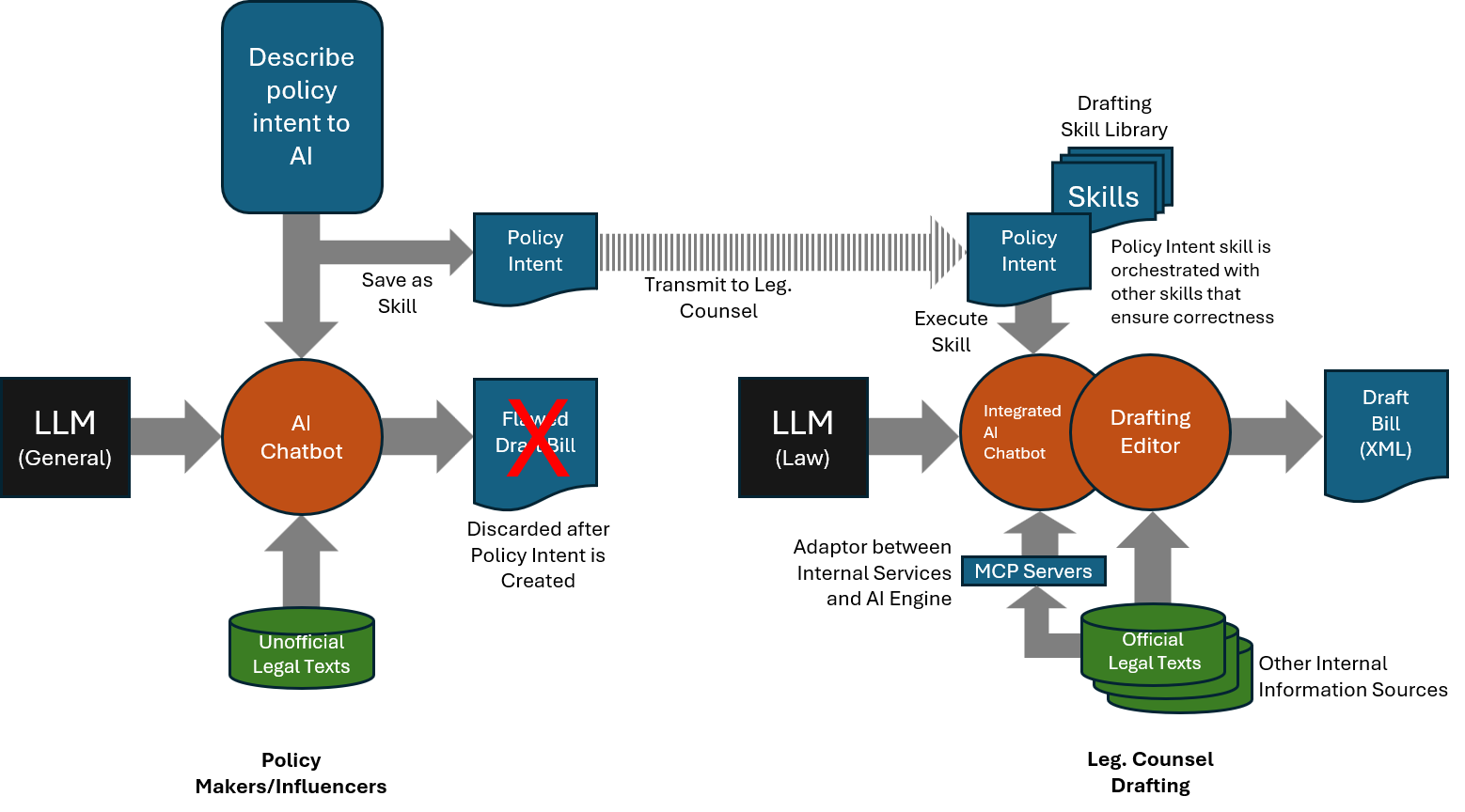
A skill is quite easy to create in a platform, like Claude or Skill.yo. You simply explain to the chatbot what you are trying to get, get a response, and then iterate providing more and more information and instructions until you get the result you think is right. Then you save that conversation as a skill.

Skills can be quite sophisticated. They can have a UI. And they are reusable.

Now, imagine that the skill is the description of policy intent. They’ve refined it as far as they can, even though it’s not perfect. But rather than delivering an imperfect result, they instead deliver the skill to Leg. Counsel as their expression of policy intent.

Leg. Counsel, with a skill enabled drafting editor, can then take the policy intent skill they receive, run it against the official texts they have, and under the stewardship of a qualified drafter, refine the result taking into account all the considerations that are invisible to someone trying to draft on the outside.

What is more, a skill enabled drafting editor would have other abilities as well – allowing the drafters in Leg. Counsel to create their own library of skills to perform all the dreary tasks that hamper their productivity without surrendering the overall responsibility for drafting over to an AI chatbot.

There are some very serious concerns that needs consideration and guardrails that need to be implemented. Whenever someone interacts with an AI chatbot, there is a risk of piercing any confidentiality bubbles that might be in place. While the conversation won’t immediately be used by the LLM, the AI vendors don’t guarantee that they won’t use the chats for future training. This is called Vendor Data Retention. The problem can be circumvented by paying for Zero Data Retention (ZDR), but it’s very costly – reflecting the value of using chat conversations for future training. This has to be given a lot of consideration.

All of this is just food for thought…

Standard
Artificial Intelligence, technology

Government’s Responsibility in the Age of AI

I’ve recently seen several articles on how AI is affecting government. It’s something I’ve been thinking about for a while, and my involvement in Bussola Tech events has pulled me further into it.

It’s time to weigh in. While the world debates the policies and regulations needed to address AI’s risks and opportunities, I want to focus on something more fundamental: the responsibilities governments have right now.

It’s easy to get swept up — excited about what’s possible, or fearful of the consequences. But governments need to focus on the immediate responsibilities in front of them. I’ll break these into three categories: what governments must do, what they should do, and what they could do.

What Government Must Do

When AI platforms are trained, they ingest large volumes of static information from sources like websites, databases, and user chats. Where that information comes from, and how credible it is, matters. Governments have a responsibility to publish AI-ready information in a way AI platforms can use.

Years ago, it was fine to publish information online in a format only a human could read. Search engines changed that by requiring machine-readable formats. Now AI is changing the bar again. That creates new responsibilities:

  • Be the source of official information. Governments must be the primary source for official information and must publish it so AI platforms can discover it, understand it, and ingest it accurately.
  • Be discoverable and accessible. Information hidden behind a login or a form is invisible to AI platforms looking for static content. Unstructured formats have the same effect: a human might understand the document, but an AI platform training on a huge corpus of text will likely skip over it.
  • Be meaningful. Governments need to understand how AI platforms learn. The way information should be structured and presented varies by content type — there’s no single right answer, and the right answer keeps changing.
  • Be accurate, timely, and clean. Published information must be current, correct, and free of anything sensitive that shouldn’t be learned by an AI platform. Legislative documents can contain sensitive material — for example, notes protected by attorney-client privilege hidden in invisible comments. That needs to be stripped out before publication.
  • Be trustworthy. Governments are responsible for being the trusted source of official information. That’s a serious responsibility: publishing misinformation undermines government credibility and can cause AI engines to rank the government’s information lower — accurate or not. And if government isn’t a reliable source, unofficial and less authoritative sources will fill the gap.

What Government Should Do

The list above covers the minimum. Beyond that, governments should also:

  • Be authentic. Being the source of truth isn’t just about providing information — it means guaranteeing that what’s delivered matches what was enacted into law or officially published, unaltered. Usually, it means providing digital signatures and ensuring encryption throughout the pipeline. However, this is a nuanced problem, and as far as I know, today’s AI platforms don’t verify digital signatures during training.
  • Be authoritative experts. Government websites often provide bare facts without the supporting context that establishes expertise. Governments should consider how this affects whether AI platforms favor a less official but more authoritative-seeming source instead. That might sometimes be fine — but it can also open the door to harmful exploitation.
  • Be genuine. Governments carry inherent public trust, so it’s essential they avoid publishing synthetic or AI-generated content under the banner of being a source of truth.

What Government Could Do

AI platforms are trained on a large corpus of static information, producing a language model with general understanding. But for many tasks AI is used for today, that’s not enough — platforms also need up-to-date information, real-time events, and the ability to act through the services they connect to.

The Model Context Protocol (MCP) addresses this. Servers that implement MCP give AI applications three core capabilities:

  1. Access to resources (note that this does not enable real-time learning)
  2. Tools to execute APIs
  3. Reusable prompt templates for specific tasks

This unlocks a lot for AI applications — but it also means governments need to carefully think through their responsibilities in offering agent-ready services:

  • Be harmless. Any time programmatic services are exposed — to humans or to AI agents — there’s potential for exploitation. Appropriate safeguards need to be built in to ensure against an AI application going rogue.
  • Be secure. Closely related to the last point, MCP servers need to be designed with security and privacy in mind. Information that is available to an MCP server should be separated from the internal operations entirely. The same considerations that apply to separating trusted internal networks from untrusted networks like the Internet using techniques like a DMZ (demilitarized zone) should be applied with building MCP servers if those servers are to be made public.
  • Be useful. Exposing real-time information without thinking through how it will be used doesn’t solve a real problem. It’s worth noting that MCP servers aren’t used to train an LLM — they only answer specific runtime questions. This means they can’t be used to teach a model a new corpus of documents. Designing MCP servers that work well with AI platforms is a distinct skill that takes careful thought.
  • Be cautious. Programmatic capabilities can reduce AI hallucinations by giving platforms access to information they weren’t trained on. But this also creates the risk of AI answering questions it shouldn’t — for instance, generating an artificial interpretation of the law that goes beyond what’s officially published. Some things should still be handled by qualified humans. It is better to error on the side of caution.

In Conclusion

Governments have a responsibility to provide AI-ready information to the AI platform in a way that ensures the information is accurate, timely, and trustworthy. What is now emerging is the added need to provide AI-agent-ready services that provide access to real-time information and capabilities to AI-based applications. Rather than rushing to take advantage of these new capabilities, governments need to exercise caution to ensure that the new functionality they provide through these capabilities are useful and don’t have unintended consequences.

Standard
Artificial Intelligence, Standards, technology, Transparency, Uncategorized

Report on the Bussolo Tech AI Conference in Brasilia, Brazil

This past week I attended a conference in the Brazilian capital of Brasilia, hosted by the Brazilian Senate and organized by Bussola Tech and the Organization of American States (OAS). The theme of the conference was “Structuring the Digital Legislative Process for Integration with Public Artificial Intelligence Interfaces”.

This conference was one in a series of conferences I have attended over the past couple of years where the emergence AI has been the focus.

I gave a talk on some of the AI projects we are working on at Xcential and how structured data enables them. Later, I participated in a panel discussion with many familiar faces. The panel was chaired by Wade Ballou, the former Legislative Counsel for the U.S. House of Representatives along with Monica Palmirani from the University of Bologna, Fotis Fitsilis from the Hellenic Parliament, and Juliano Bringer from Agape Consulting. The topic explored the theme of the conference from our various perspectives.

There were a number of interesting points made at the conference ranging from how AI is already being used in support of legislative drafting and to improve citizen engagement to the concerns of how AI will affect human critical thinking skills and the environmental impact of the massive electrical and cooling resources needed to maintain the data centers that provide AI services.

All these points got me thinking more about what our response to AI should be. AI is clearly the next big thing and is already profoundly changing how we, as humans, live our lives. As with every development, there will be winners and losers. Those who adapt and take advantage of the new capabilities will profit while those who can’t adapt will find themselves sidelined by progress.

However, there is also a more insidious side to the emergence of AI in our society. Like social media before it, despite all the positive changes it can bring, it can easily be exploited to harm society. How we prepare for AI will determine whether it ends up being a net positive or net negative to the world.

In my coming blogs, I’m going to explore these points further.

Standard