Lawsuit, Process, technology, Transparency

Transparent legislation should be easy to read — part II

I have some good news to share. After almost two years under the cloud of litigation regarding a challenge to one of our patent applications, we have reached a settlement that concludes the issue. The Patent Trials and Appeals Board (PTAB) ruled in our favor by denying the patent derivation claim made against us. This was on top of earlier rulings in our favor. What is more, both our patent applications have now been allowed.

While the terms of the settlement remain confidential, this has been a costly exercise for us. For me personally, this was very difficult. Not only did I have to defend my honor and integrity, but I have had to spend half of my personal life savings in the defense of Xcential – with no guarantees that I will ever be able to recoup that expense. Using my own savings for a lot of the legal bills was the only way to ensure that Xcential would be able to go on. This has certainly affected my life.

If there is something good to come out of this exercise, it is validation that we’re onto something very valuable.  With the litigation behind us and both patents in our pocket, we are now able to proceed forward with our plans to serve our markets – selectively, of course,

Over a decade ago, I wrote a blog questioning why federal bills are written the way they are. For someone experienced with state legislation, federal legislation is quite cryptic and difficult to understand. It turns out that the style of amending law found in federal legislation is the common form and can be found around the world. In the U.S. Congress, this style is known as cut and bite1 amending. With this style, individual word changes are spelled out in a narrative form. For example, here is a section from California Assembly Bill 2748 from the current session:

SECTION 1.  Section 21377.5 of the Water Code is amended to read:

21377.5.  (a) Notwithstanding Section 21377 of this code or Section 54954 of the Government Code or any other provision of law, the Board of Directors of the Tri-Dam Project, which is composed of the directors of the Oakdale Irrigation District and the South San Joaquin Irrigation District, may hold no more than four regular meetings annually at the a Tri-Dam Project offices. The Board of Directors of the Tri-Dam Project shall adopt a resolution that determines the location of the Tri-Dam Project offices. office that is located in Sonora, California, or Strawberry, California, or within 30 miles of either city.

(b) The notice and conduct of these meetings shall comply with the provisions of the Ralph M. Brown Act (Chapter 9 (commencing with Section 54950) of Part 1 of Division 2 of Title 5 of the Government Code).

You can clearly see what changes are being made. However, if written using cut and bite amending, this equivalent section would read something like:

SECTION 1.  Section 21377.5 of the Water Code is amended by:

(a) Deleting the sixth “the” and replacing it with “a”.

(b) After “Tri-Dam Project”, deleting to the end of the subsection and replacing withoffice that is located in Sonora, California, or Strawberry, California, or within 30 miles of either city.”

This very terse form of amendment gives no context for the change being made. The change in subsection (a) is completely meaningless without any context. What this all means is that a politician tasked with approving these changes must do a significant amount of work to understand what the changes are all about and why they are being made.

Back in 2013, I questioned why the form found most of the U.S. states including my state of California wasn’t used. As seen in the example above, the U.S. states use a different approach to amending – known as amending in full. In this style of amending, the entire section containing the change is restated and the change is shown (some of the time) as stricken and inserted text, as you would find with track changes in a word processor. This approach has the benefit of making the change much clearer by providing the complete context of the change. In California, this approach is mandated by the State Constitution as amended by Proposition 1-a of 1966. This proposition was overwhelmingly approved by the voters of California. The Speaker of the California Assembly at the time, Jesse Unruh, had pushed through this constitutional amendment to establish professional legislature less beholden to special interests that other pressures that were undermining the effectiveness of the legislature at the time. His reforms were quite sweeping. Among the many changes, one part of this initiative was to make legislation more transparent.

The specific provision that was added, Section 9 of Article IV of the California Constitution, reads:

“A statute shall embrace but one subject, which shall be expressed in its title. If a statute embraces a subject not expressed in its title, only the part not expressed is void. A statute may not be amended by reference to its title. A section of a statute may not be amended unless the section is re-enacted as amended.”

This section of the California Constitution contains two rules. The first is the single subject rule, which limits the scope of each statute. The second is the re-enactment rule, which mandates the amendment in full approach, requiring that each section amended by re-enacting the whole section (essentially a repeal of the prior section and enactment of a new amended section as a single action). Most U.S. states have these same rules or very similar rules. These two rules go together. One of the worries of the re-enactment rule is that, by opening an entire section for re-enactment, unwelcome amendments might be added as part of the political process of winning votes. The single-subject rule is a guard against that behavior.

At the time of my original blog, I learned that adopting these rules in Congress would be impossible. For one thing, the U.S. Code is less regular than state codes or revised statutes, especially in the non-positive titles, and that re-enacting an entire section would be quite complex and could cause other difficulties. Re-enactment rules require consistently bite-sized sections. In addition, the House’s equivalent of the single subject rule, the germaneness rule adopted in 1789, didn’t have quite the same effectiveness as the single subject rule of California. Apparently, the Senate’s equivalent rules, found in the Senate Standing Rule XVI and Rule XXII had even more limited applicability.

As a result, I proposed in my blog that amendments in context be used. With amendments in context, a proposed bill is drafted using the amendments in full style that U.S. states use, from which a cut and bite style bill is generated using automation. With this approach, you get the best of both worlds. The bill is drafted in a form that is easy to understand and easy to manage while the worries of unleashing this amending style are circumvented by retaining the existing amending style for parliamentary procedures. However, at the time, the technology just wasn’t available. Under contract to the Law Revision Counsel, Xcential was just beginning down the path of converting the U.S. Code to processable XML that could feed the automation tools. While we had tools to offer that could do amendments in context, we were constrained by our agreement with California as to how much of our technology could be reused – they had been worried we could inadvertently undermine the successes of Proposition 1-a by empowering the special interests with our technology.

Today, more than a decade later, much has changed. The U.S. Code is available in an XML format we designed and a new more modern LegisPro is available that is both web-based and much more powerful than what we had back then. But there have been other changes too. The Posey Rule has been adopted requiring that a comparative print be provided alongside all proposed law showing how the law will be affected. This comparative print is also generated by Xcential technology and alleviates much of the problem by allowing politicians to understand more easily what it is they are voting on. However, it leaves the complexity of drafting and managing the process of creating and managing the cut-and-bite amendments still to be addressed.

This problem isn’t limited to U.S. federal bills. It’s a common problem wherever cut and bite amending is employed, particularly in Commonwealth countrie or countries with Westminster based legislative traditions, even if the term cut and bite isn’t used.

At Xcential, we’re going to return to our core mission – to make government processes better through technology. Our goal is improved efficiency, increased accuracy, and most importantly, better transparency for the benefit of the citizens.

  1. The term cut and bite is also sometimes used to refer to the form of amending used to propose amendments to bills themselves. Another term for these types of bill amendments are page and line amendments as they usually are expressed as references to page and line numbers rather than to provisions. ↩︎
Standard
Lawsuit, technology, Track Changes, Transparency

Lawsuit Update and a Tale about Bicycles

In the past couple weeks, the first two court rulings have come out concerning our battle with the Akin Gump law firm. Both rulings have been in our favor. The first ruling denied Akin Gump’s motion to dismiss, instead allowing four of the five claims in our countersuit – with the judge calling them “plausible”. The second ruling denied Akin Gump’s attempt at a preliminary injunction to stop us from responding to actions from the U.S. Patent Office. The judge found that “there is not a substantial likelihood that (Akin Gump) will prevail,.” She then added “(T)o preclude Xcential from moving forward…would discourage invention, it would discourage innovation, it would discourage companies from investing their own resources to try to come up with workable solutions to commonly identified problems,.”

After reading the transcript, I have an interesting analogy to make. It is based on an analogy that the Akin Gump attorney chose to use – comparing our dispute to that of inventing a bicycle. While it’s not a perfect analogy, it is still a very good analogy.

Imagine you have an idea for a two-wheeled mode of transportation that will help you do your job more effectively. You discover that this idea is called a bicycle and that there are several bicycle manufacturers already – so you approach one to see if their product can do the job. While this company did not invent the bicycle, they specialize in making them and have been doing so for many years. This company only make bicycles. They are not the manufacturer of the commodity materials that make up a bicycle such as the metal tubing or even the tools that bend the tubes to make handlebars. While not a household name, they are very well known among bicycle enthusiasts around the world.

However, you discover that there is a problem. In the highly regulated world of bicycles (maybe automobiles would have been a better analogy), this bicycle maker doesn’t have a bicycle that conforms to your local regulatory market. You have a quick 30-minute call with the bicycle maker, and they say they’re familiar with the regulations in your market, but that making the changes your local regulations require and getting those changes certified is a costly business and is only done for customers willing to help foot the bill. You indicate that you’re still interested and accept their suggestion that they build a prototype, at no charge, of the bicycle that is suitable for your regulatory market. You send them a hand drawn map of the routes you want to ride the bicycle on so that they can understand the regulatory concerns that might apply.

With the suggestion of funding, the bicycle maker goes off starts building a demonstrable prototype of a modified bicycle model that conforms to your local regulatory requirements. As a potential customer for this localized version of the bicycle, you get limited updates from the salesperson you were working with to ensure that you’re still interested and to indicate that the prototype hasn’t been forgotten. He makes a point of buttering you up, as salespeople are wont to do. You never interact with the engineers building the prototype at all.

It turns out that the regulations require mudguards over the wheels and reflectors on the front and rear. In the process of attaching these parts, the engineers at the bicycle company come up with some nifty brackets for attaching the mudguards and reflectors to the bicycle frame in accordance with the regulatory requirements. While the mudguards and reflectors are commodities, the brackets used to attach them are novel, so the engineers apply for patent protection for these brackets. You play no role in the design or manufacture of these brackets.

When the bicycle maker brings their modified bicycle to your office to show you what can be done, you’re wowed by the result, but don’t really have the budget to help cover the cost of getting the changes certified. The bicycle company shelves the project without a paying customer.

Later on, while pondering whether to patent your idea for a bicycle, you come across the bicycle maker’s patent application. Without much of an understanding into the making of bicycles, you conflate the general idea for a bicycle (it was invented decades earlier and is prior art at this point), a bicycle that is adapted to your regulatory market (not something that is patentable), and the nifty brackets that hold the reflectors and mudguards on the frame and are necessary to achieve regulatory compliance in your local market (and that you played no part in designing or manufacturing – but are patentable).

Standard
Uncategorized

Mapping Amending Language to Akoma Ntoso Modifications

In my last blog, I talked about Xcential’s long history working with change management as it applies to legislation and my personal history working in the subject in other fields.

In this blog, I’m going to focus in on change management as it is used in Akoma Ntoso. I’m going to use, as my example, a piece of legislation from the California Legislature. As I implemented the drafting system used in Sacramento (long before Akoma Ntoso), I have a bit of a unique ability to understand how change management is practiced there.

First of all, we need to introduce some Akoma Ntoso terminology. In Akoma Ntoso, a change is known as a modification. There are two primary types of modifcations:

  1. Active modifications — modifications in which one document makes to another document.
  2. Passive modifications — modifications being proposed within the same document.

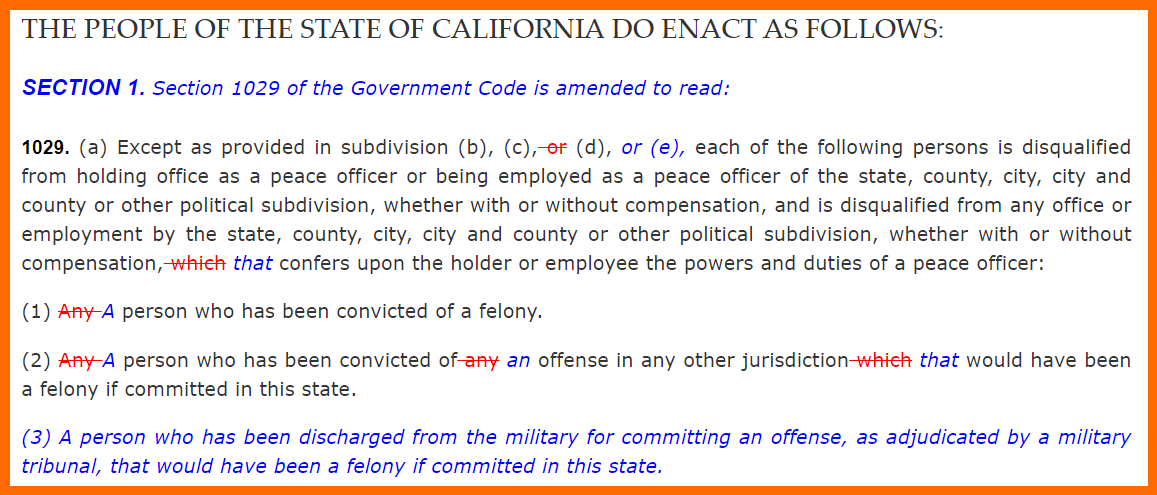
The snippet I am using for example is a cropped section from AB17 from the current session:

In California, many changes are shown using what they call redlining — or you may know as track changes. However, it would be a mistake to interpret them literally as you would in a word processor — a bit of the reason why it’s difficult to apply a word processor to the task of managing legislative changes.

In the snippet above, there are a number of things going on. Obviously, Section 1 of AB17 is amending Section 1029 of the Government Code. Because California, like most U.S. states, only allows their codes or statutes to be amended-in-full. The entire section must be restated with the amended language in the text. This is a transparency measure to make it more clear exactly how the law is being changed. The U.S. Congress does not have this requirement and Federal laws may use the cut-and-bite approach where changes can be hidden in simple word modifications.

Another thing I can tell right away is that this is an amended bill — it is not the bill as it was introduced. I will explain how I can tell this in a bit.

From a markup standpoint, there are three types of changes in this document. Only two of these three types are handled by Akoma Ntoso:

  1. As I already stated, this bill is amending the Government Code by replacing Section 1029 with new wording. This is an active change in Akoma Ntoso of type insertion.
  2. Less obvious, but Section 1 of AB17 is an addition to the bill as originally introduced. I can tell this because the first line of Section 1, known in California as the action line, is shown in italic (and in blue which is a convention I introduced). The oddity here is that while the section number and the action line are shown as an insertion, the quoted structure (an Akoma Ntoso term), is not shown as inserted. The addition of this section to the original bill is a passive change of type insertion.
  3. Within the text of the new proposed wording for Section 1029, you can also see various insertions and deletions. Here, you have to be very careful in interpreting the changes being shown. Because this is the first appearance of this amending section in a version of AB17, the insertions and deletions shown reflect proposed changes to the current wording of Section 1029. In this case, these changes are informational and are neither an active nor passive change. Had these changes been shown in a section of the bill that had already appeared in a previous version of AB17, these these changes would be showing proposed changes to the wording in the bill (not necessarily to the law) and they would be considered to be passive changes.

The rules are even more complex. Had section 1 been adding a section to the Government Code, then the quoted text being added would be shown as an insertion (but only in the first version of the bill that showed the addition). Even more complex, had the Section 1 been repealing a section of the Government Code, then the quoted text being repealed would be shown as a deletion (and would be omitted from subsequent versions of the bill). This last case is particularly confusing to the uninitiated because the passive modification of type insert is adding an active modification of type repeal. The redlining shows the insertion as an italic insertion of the action line while the repeal is being shown as a stricken deletion of the quoted structure.

The lesson here is that track changes, as we may have learned them in a word processor, aren’t as literal as they are in a word processor. There is a lot of subtle meaning encoded into the representation of changes shown in the document. Being able to control track changes in very complex ways is one of the challenges of building a system for managing legislative changes.

Standard
Uncategorized

Xcential is a Change Management Company

At Xcential, we typically describe ourselves as a legislative technology company. While that is correct, the true answer is more nuanced than that. We purposefully don’t solve problems that are mainstream and relatively easily solved by other off-the-shelf software. Instead, we say that we focus on drafting but, in saying that, we understate what we do. In practice, we focus on a very complex and high-value problem called change management — as it relates to legislation. Few people truly know how to solve this problem.

Twenty years ago, the founders of Xcential worked at an XML database company that was a subsidiary of Xerox. We started Xcential because we thought the legislation was one of the best applications for XML we had ever come across. It was the change management aspects that fascinated me, in particular. While my knowledge of legislation was based on high school civics class, I had a lot of experience in the field of change management.

At the start of my career, I was an electronics design engineer at the Boeing Company. While there, I worked on a very sophisticated form of change management — concurrent fault simulation of behavioral representations of electronic systems. Fault simulation is a deliciously complex differencing problem. In legislation, we think of changes as amendments to the text and we record them as insertions and deletions. In fault simulation, the changes aren’t textual, they are behavioral. We record those changes as observable differences from expected results in something called a fault dictionary. With this dictionary of simulated faults, you are able to backtrack to predict which likely faults are causing the problem.

While managing amendments and managing faults in an electronic system might seem a world apart, algorithmically they are surprising similar. In an amended bill, the objective is to efficiently record changes to a document as deltas (differences) recorded inline within the original text. When simulating an electronic system, the objective is to record thousands of potential failures as shadow circuits (differences) against a single good simulation executing concurrently. The shadow circuits, while a dynamic part of a simulation run, are very analogous to the changes recorded in a document. It’s a very clever techniques for efficiently simulating the behavior of thousands of things that might go without having to run thousands of individual simulations.

Getting my head around the complexities of concurrent fault simulation taught me how to think in a world of asynchronous recursion — electronic systems are inherently asynchronous. Complex recursion in legislative documents is something I must frequently wrestle with, from parsing and responding to complex requests for documents or parts of documents in the URL Resolver to managing the layers of sets of changes that exist in the U.S. Code as laws are amended.

Change management has a lot of applications — not just in managing faults in an electronic circuit or amendments in legislation. Another project at Boeing that I was not directly involved with involved allowing every airliner coming off the assembly line to have it’s own unique document configuration that would evolve through the thirty or so years the aircraft was in service. So many possibilities…

Standard
Process, technology, Uncategorized

GitHub Copilot — Is it the future?

Several months ago, I got admitted to the GitHub Copilot preview. For those of you who don’t know what Copilot is, it’s a AI-based plugin to Visual Studio Code that helps you by suggesting code for you to type. If you like, the suggestion, you hit tab, and on you go.

Join the GitHub Copilot waitlist · GitHub

It may sound like magic, and in some ways, it does seem like that. Apparently, it learns the vast base of open-source code found in the GitHub repositories. This, of course, has led to the inevitable charges that it violates fair use of that code and even that it will ultimately replace developer’s jobs much as factory automation has replaced workers. From my experience, this is more about sensationalism than anything real to worry about.

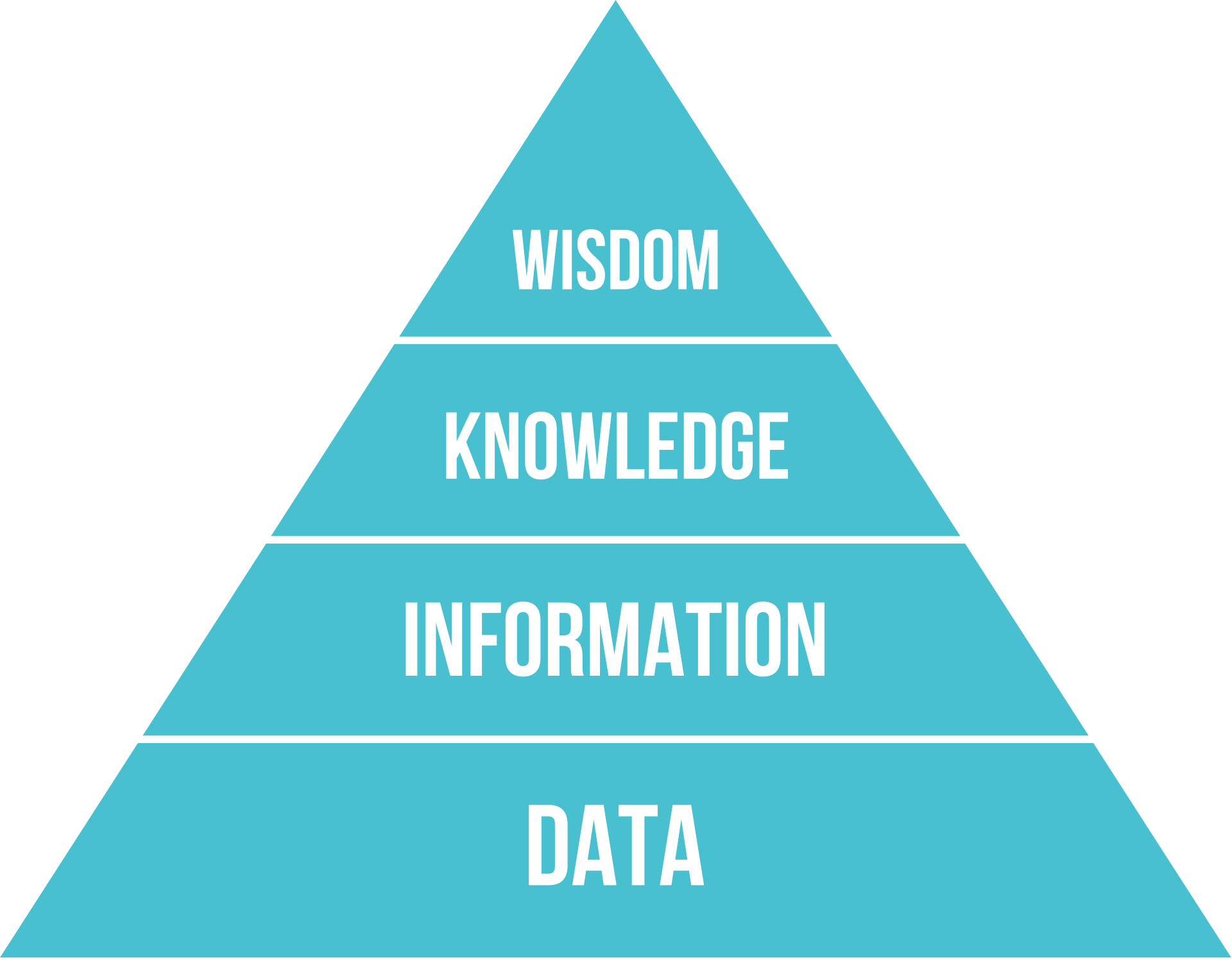
In my recent posts, I’ve covered the DIKW pyramid. It seems we’ve been stuck in the information layer for a long time, only barely touching the knowledge layer in very rudimentary ways. Yes, there are tools like Siri and Alexa which claim to be AI-based virtual assistants, but they just feel like a whole bunch or complicated programming to achieve something that is more annoying than helpful. There is Tesla Copilot for self-driving cars, but that just seems scary to me. (Full disclosure: I don’t even trust cruise control) To me, GitHub copilot is the first piece of software that truly seems to drive deep into the knowledge layer and even reach the wisdom layer. It’s truly simulating some sort of real smartness.

While the sensationalists love to make it seem that Copilot is lifting code from other people’s work and offering it up as a suggestion, I’ve seen nothing whatsoever that suggests that that is what it is doing. Instead, it truly seems to understand what I am doing. It makes suggestions that could only come from my code. It uses my naming conventions, coding standards, and even my coding style. It seems to have analyzed enough of the code base in my application to understand what local functions and libraries it could draw upon. The code it synthesizes are obviously built on templates that it’s derived by learning. But those templates aren’t just copies of other people’s work. This is how synthesis works in the CAD world I come from (actually, it’s a bit more sophisticated that the synthesis I knew in CAD many years ago) and this is a natural next step in coding technologies.

I’ve been experimenting with what Copilot can do — how far reaching its learning seems to be. It’s able to help me writing JavaScript. What it is able to suggest is remarkable. However, coding assistance is not its only trick. It even helps with writing comments — sometimes with a bit of an attitude too. Last week I was adding a TODO: comment into the loader part of LegisPro to note that it needed to be modernized. Copilot’s unsolicited suggestion for my comment was “Replace the loader with a real loader”. Thanks Copilot. As Han Solo once said, “I’m not really interested in your opinion 3PO”.

Of course, this all leads to the inevitable question. Can it be trained to write legislation? Much to my surprise, it seemingly can. How and why it knows this is completely unknown to me. It’s able to suggest basic amending language and seems to know enough that it can use fragments of quotes from Thomas Jefferson and Benjamin Franklin. I find it incredible that it can even understand the context of legislation and that I did not have to tell it what that context was.

So am I sold on this new technology? Well, yes and no.

It’s not the scary source code stealing and eavesdropping application some would make it out to be. The biggest drawback to it is the same reason I don’t even trust cruise control in my car. It’s not that I don’t trust the computer. It’s that I don’t trust myself to not become lazy and complacent and come to believe the computer is right. I’ve already come across a number of situations where I’ve accepted Copilot’s suggestion without too much thought, only to needlessly wasting hours tracking down a problem that would never have existed if I had actually taken the time to write the code.

It’s an interesting technology, and I believe it’s going to be am important part of how software development evolves in the coming years. But as with all new technologies, it must be adopted with caution.

Standard
Uncategorized

Comparing DOCX to Akoma Ntoso for Legislation

After describing what makes for good legislative XML, I feel I should bring up a favorite topic of mine — why word processors don’t make for good legislative drafting tools.

Lately, we’ve been implementing round tripping tools to allow Akoma Ntoso documents to be imported and exported from Microsoft Word. This is to facilitate migration from a largely office productivity-oriented system to an XML-based one and to allow the exchange of documents with external clients that don’t have access to the internal systems being used to draft and manage legislation. It’s been quite a difficult process. The round-tripping itself has been quite straight forward. Exporting a document is relatively easy and reimporting that exported document, unchanged, isn’t difficult. What is very problematic is trying to ingest documents drafted or extensively edited using a word processor. The DOCX markup quickly becomes a tangled mess. Even when a document looks fine visually, there can be a lot going wrong on the inside, revealing the drafter’s struggle with the word processor to get a document that at least looks right. To avoid the problematic mess, we tend to resort to interpreting the words and discarding the structure and internal metadata entirely. It’s not perfect, but it’s at least manageable.

I’m going to compare the prominent word processing format today, DOCX (well, at least the WordprocessingML part of it) to Akoma Ntoso in respect to how they stack up to each other on my list:

  • Is it semantic?
    DOCX: No, not at all. DOCX is a serialization of the inner workings of Microsoft Word. It makes no attempt to be anything else.
    Akoma Ntoso: Yes, this is the fundamental approach Akoma Ntoso takes.
  • Is the presentation separated from the semantics as much as possible?
    DOCX: No, the presentation is tied directly into the document itself, and what’s more, is very proprietary.
    Akoma Ntoso: Yes, although you can apply presentation directly inline in cases, such as tables, where necessary.
  • Is all the text (excluding any metadata section) in the natural reading order?
    DOCX: Yes, for the most part.
    Akoma Ntoso: Yes, for the most part.
  • Does it, to the fullest extent possible, avoid the use of generated text?
    DOCX: No, and this is one of the most frustrating and infuriating parts of working with DOCX.
    Akoma Ntoso: Mostly, but it doesn’t preclude practices that ensure this rule is followed.
  • Is every provision that needs data associated with it permanently identifiable?
    DOCX: Mostly.
    Akoma Ntoso: Yes, via the @wId or the @GUID attributes.
  • Is every provision that is referred to easily locatable?
    DOCX: Not without extensive customization.
    Akoma Ntoso: Yes, via a standardized locator mechanism using the @eId/@wId attributes.
  • If the XML schema is for general use, is there an extensible way to add missing constructs?
    DOCX: No, unless you regard styling as your constructs (a bad idea) or want a complex customization task.
    Akoma Ntoso: Yes, via the seven elements found in the generic model.
  • Is there an extensible metadata mechanism?
    DOCX: Yes, but it’s complicated.
    Akoma Ntoso: Yes, but it’s complicated.
  • Does it provide the facilities necessary to automate according to modern expectations?
    DOCX: No, the presentation oriented structure of DOCX does little to enable downstream automation.
    Akoma Ntoso: Yes, Akoma Ntoso encourages a hierarchical content structure that is ideal for downstream automation.

Of course, Akoma Ntoso looks a lot better for legislative documents than does DOCX files. That should be no surprise — Akoma Ntoso is purpose-built for legislation while DOCX is a general purpose document model intended for no single purpose. But it is also fundamentally very different. While Akoma Ntoso is designed to be in modern standards-based document information model for legislation, DOCX is a serialization of the archaic data structures that exist within Microsoft Word. DOCX reflects the proprietary inner workings of Microsoft Word rather than the semantic meanings to be found within a document.

Akoma Ntoso has its drawbacks too. It’s complex, a bit academic, and has to span a very broad range of legal traditions make it a good fit for most legislative traditions, but a perfect fit for none.

Standard
Akoma Ntoso, Standards, technology, Uncategorized

What is Good Legislative XML?

I’m often asked what make on XML model better than another when it comes to representing laws and regulations. Just because a document is modeled in XML does not mean that it is useful in that form — the design of the schema matters in terms of what it enables or facilitates.

We have a few rules of thumb that we apply when either designing or adopting an XML schema:

  • Is it semantic?
    Reason: In order to process the information in a document, you have to understand what it is and what it means.
  • Is the presentation separated from the semantics as much as possible?
    Reason: We have moved beyond paper and nowadays it’s important to present information in form factors that just don’t suit the legacy constraints imposed by printing paper.
  • Is all the text (excluding any metadata section) in the natural reading order?
    Reason: The simplest way to present and process the text in a document is in the reading order of the text. This is particularly important is the presentation is to be added to the XML using simple CSS styling (as opposed to HTML transformation) and when the text is subject to complex amending instructions.
  • Does it, to the fullest extent possible, avoid the use of generated text?
    Reason: Similar to the last rule, it’s important for text to be displayed or amended when that text is represented. Generating text opens up a can of worms which can require sophisticated additional processing. Also, from a historical record of the text, which is essential for enacted law, having part of the text be generated by an external algorithm requires that the algorithm itself become part of the permanent record.
  • Is every provision that needs data associated with it permanently identifiable?
    Reason: With modern automation comes the need to not only manage the text of a provision but also state information. For example, is the current status of the provision pending, effective, repealed, or spent? While some of the metadata might be stored with the XML representation of the provision itself, sometimes it is better to store that metadata in a separate part of the document or in an external database. In these cases, it’s important to be able to permanently associate this external metadata with the provision — and this usually requires an immutable (permanent) identifier.
  • Is every provision that is referred to easily locatable?
    Reason: Laws are full of references (or citations). These are to provisions within the same document or to other documents or provisions within those documents. There needs to be a way to accurately and efficiently traverse and process these references. This need usually requires a locating identifier that an unambiguously identify the provision being referred to.
  • If the XML schema is for general use, is there an extensible way to add missing constructs?
    Reason: It is easy to claim to support all the legal traditions in the word, but extremely difficult to do so. While legal traditions are remarkably similar around the world, it’s impossible to predict every single construct that will arise — especially with documents data back hundreds of years. There has to be a way to implement constructs that don’t intrinsically exist within the base XML schema.
  • Is there an extensible metadata mechanism?
    Reason: A primary objective for representing a legislative or regulatory document in XML is for the processability it enables. This invariably means a need to record extensive metadata about the provisions found within the document. As the automation possibilities are endless, there needs to be a way to model and record the metadata that is generated.
  • Does it provide the facilities necessary to automate according to modern expectations?
    Reason: Some structure facilitate automation while others do not. For instance, flat structures can simplify the drafting process, but also make the automation process more difficult. It’s usually better to implement hierarchical structures and then hide the drafting complexity that creates with richer tools.

Standard
Uncategorized

Twenty Years in Legal Informatics!

Today marks my twentieth year in the field of legal informatics. It was January 4th, 2002 that we officially started Xcential. The following week, Brad and I flew up to Sacramento to start our new project to replace California’s aging mainframe system with a modern XML-based drafting system. At the time, with a background in CAD automation, I was relying on what I remembered from high school civics class in high school as my understanding of the field. We’ve come a long way in those twenty years.

When we arrived in Sacramento, our charter was to work closely with the Legislative Data Center to produce a legislative drafting, amending, and publishing solution. The accompanying workflow system would be developed in-house and the database-oriented history system was to be developed by another vendor. There were a few constraints — the system had to be XML-based, the middle tier had to be Enterprise JavaBeans (EJB) and use WebLogic, and the database had to be Oracle. This last constraint had been decided somewhat mysteriously by upper management in the wake of 9/11 and left us scrambling to figure out how XML and an SQL-based relational database would work together. Fortunately, we learned that Oracle was developing XDB and they were open to using us as a guinea pig, for better or worse.

At the time we didn’t realize it, but we were the replacement for an unsuccessful attempt to build a drafting system using Microsoft Word. Somewhat strangely, while that project was wrapping up the same month we were starting, we never got any wind of that project’s existence and, to this day, I’ve never heard anyone ever mention anything about that project in Sacramento. The only hint we got was that we were expressly forbidden from suggesting Microsoft Word as the drafting tool. It was only when we came across the owner of the company that had performed that project at a conference and he bitterly suggested our project would meet the same fate as his, that we realized the project had existed at all. Thankfully, he was wrong and we deployed our solution in late 2004 for the 2005-2006 session. It’s been in use ever since.

So what has changed in the twenty years I’ve been in this field. Well, a lot has changed — and a lot has not. In my last two blogs I’ve discussed the DIKW pyramid and written about how it should be expected that migration through the layers can be expected to take between ten and twenty years.

When we started in 2002, the majority of jurisdictions were still mired in the tail end of the “data” era — having data entry to enter documents into mainframe systems. Other than that, there was little automation. A number of jurisdictions were starting to move forward into the “information” era. There were two distinctly different approaches being taken. Many jurisdiction, as California had done before us, were taking a half-step into the new era using office productivity tools. The reason I consider this a half-step is because, while clearly a more modern approach than data entry into a mainframe, the step did little to prepare for the steps to come — being able to add layers of automation to increase the speed, volume, and efficiency of processing legislation. This was the lesson California had learned with their earlier project, and others have learned since — that without a robust semantic information model, you just can’t build robust automation tools. Many jurisdictions did understand this and were working towards a full step using XML-based tools. Although XML tools at the time were decidedly first generation, the benefits that automation promised outweighed the risks of being an early adopter.

So where are we today? While twenty years ago, most jurisdictions were at the end of the “data” era and start of the “information” era, there has been considerable, if slow, progress. Today most jurisdictions are either somewhere between the midpoint of the “information” era (mostly the office productivity approach) and into the early stages of the “knowledge” era (with the XML approach). Many of the systems deployed in the mid-2000s are now starting to age out and jurisdictions are looking to replace them with systems that can meet the modern demands of the 2020s.

As for Xcential, over the last few years we’ve been progressing from a consulting company to a product company — where we rely on third-party integrators to do implementations. This way we can leverage our 20 years of experience far more effectively. We still do our own implementations, when it makes sense, but we now offer LegisPro as a product that can be implemented by one of our partner companies, by a local integrator, or even by a jurisdiction’s own internal development team. Xcential today is very different from what it was 20 years ago, and our growth over the past year or so has been amazing — and for me quite exhausting.

It will be interesting to see where we are in another twenty years — although I may have retired by then. (most people roll their eyes at this point suggesting they think I’ll never want to retire)

Standard
Process, technology, Track Changes

Moving on Up to Document Synthesis

In my last blog, I discussed the DIKW pyramid and how the CAD world has advanced through the layers while the legal profession was going much slower. I mentioned that design synthesis was my boss Jerry’s favorite topic. We would spend hours at his desk in the evening while he described his vision for design synthesis — which would become the norm in just a few years.

Jerry’s definition of design (or document) synthesis was quite simple — it was the processing of the information found in one document to produce or update another document where that processing was not simple translation. In the world of electronic design, this meant writing a document that described the intended behavior of a circuit and then having a program that would create a manufacturable design using transistors, capacitors, resistors, etc. from the behavioral description. In the software world, we’ve been using this same process for years, writing software in a high-level language and then compiling that description into machine code or bytecode. For hardware design, this was a huge change — moving away from the visual representation of a schematic to a language-based representation similar to a programming language.

In the field of legal informatics, we already see a lot of processes that touch on Jerry’s definition of document synthesis. Twenty years ago, it was seeing how automatable legislation could be, but wasn’t, that convinced me that this field was ready for my skills.

So what processing do we have that meets this definition of document synthesis:

  • In-context amending is the most obvious process. Being able to process changes recorded in a marked up proposed version of a bill to extract and produce a separate amending document
  • Automated engrossing is the opposite process — taking the amending instructions found in one document to automatically update the target document.
  • Code compilation or statute consolidation is another very similar process, applying amending language found in the language of a newly enacted law to update pre-existing law.
  • Bill synthesis is a new field we’ve been exploring, allowing categorized changes to the law to be made in context and then using those changes and related metadata to produce bills shaped by the categorization metadata provided.
  • Automated production of supporting documents from legislation or regulations. This includes producing documents such as proclamations which largely reflect the information found within newly enacted laws. As sections or regulations come into effect, proclamations are automatically published enumerating those changes.

In the CAD world, the move to design synthesis required letting go of the visually rich but semantically poor schematic in favor of language-based techniques. Initially there was a lot of resistance to the idea that there would no longer be a schematic. While at University, I had worked as a draftsman and even my dad had started his career as a draftsman, so even I had a bit of a problem with that. But the benefits of having a rich semantic representation that could be processed quickly outweighed the loss of the schematic.

Now, the legislative field is wrestling with the same dilemma — separating the visual presentation of the law, whether on paper or in a PDF, from the semantic meaning found within it. Just as with CAD, it’s a necessary step. The ability to process the information automatically dramatically increases the speed, accuracy, and volume of documents that can be processed — allowing information to be produced and delivered in a timely manner. In our society where instant delivery has become the norm, this is now a requirement.

Standard
Process, technology, Uncategorized

The Knowledge Pyramid

At the very start of my career at the Boeing Company, my boss Jerry introduced the Knowledge Pyramid the DIKW Pyramid to me one evening. I had an insatiable thirst for learning and he would spend hours introducing me to ideas he thought I could benefit from. To me, this was a profound bit of learning that would somewhat shape my career.

At the time, I was working in CAD support, introducing automation technologies to the various engineering project’s around the Boeing Aerospace division. The new CAD tools were running on expensive engineering workstations and were replacing largely homegrown minicomputer software from the 1970’s.

Jerry explained to me that the legacy software, largely batch tools, that crunched data manually input from drawings represented the data layer. The CAD drawings our tools produced actually represented a digital representation of the designs with sufficient information for both detailed analysis and manufacturing. It would take a generation of new technologies to advance from one layer to the next in the DIKW pyramid — with each generation lasting from ten to twenty years. His interest was in accelerating that pace and so we studied, as part of our R&D budget, artificial intelligence, expert systems, language-based design techniques, and design synthesis.

While data was all about crunching numbers, information was all about understanding the meaning of the data. Knowledge came from being able to use the information to synthesize (Jerry’s favorite topic) new information and to gain understanding. And finally, wisdom came from being able to work predictively based on that understanding.

When I was introduced to legal informatics in the year 2000, it was a bit of a time warp to me. While the CAD world had advanced considerably and even design synthesis was now the norm, legal informatics was stuck in neutral in the data processing world of the late 1970s and early 1980s. Mainframe tools, green screen editors, and data entry was still the norm. It was seeing this that gave me the impetus to work to advance the legal field. The journey I had just taken in the CAD world of the prior 15 years was yet to be taken in the legal field. The transition into information processing was to start with the migration to XML — replacing the crude formatting oriented markup used in the mainframe tools with modern semantic markup that provided for a much better understanding of the meaning of the text.

To say the migration to the future has gone slowly would be an understatement. There are many reasons why this has happened:

  • The legacy base of laws have to be carried along — unchanged in virtually every way. This would be like asking Boeing to advance their design tools while at the same time requiring that every other aircraft design ever produced by the company in the prior century also be supported. For law, it a necessary constraint, but also a tremendous burden.
  • The processes of law are bound by hard-to-change traditions, sometimes enshrined by the constitution of that jurisdiction. This means the tools must adapt more to the existing process than the process can adapt to the tools. Not only does this constraint require incredibly adaptable tools, it is very costly and dampers the progress that can be made.
  • The legal profession, by and large, is not technology driven and their is little vision into what can be. The pressure to keep things as they are is very strong. In the commercial world, companies simply have to advance or they won’t be competitive and will die. Jurisdictions aren’t in competition with one another and so the need to change is somewhat absent.

For advancements to come their needs to be pressure to change. Some of this does come naturally — the hardware the old tools run on won’t last forever. New legislators entering into their political careers will quickly be frustrated by the archaic paper-inspired approach to automation they find. For instance, viewing a PDF on a smartphone is not the best user experience. It is that smartphone generation that will drive the need to change.

Over the next few blogs, I’m going to explore where legal informatics is on the DIKW pyramid and what advancements on the horizon will move us up to higher levels. I’ll also take a look at new software technologies that point the way to the future — for better or worse.

Standard