Process, Transparency

What is Transparency?

I’ve been thinking a lot about transparency lately. The disappearance of Malaysian Airline Flight 370 (MH370) provided an interesting case to look at – and some important lessons. Releasing data which requires great expertise to decipher isn’t transparency.

My boss, when I worked on process research at the Boeing Company many years ago, used to drill into me the difference between information and data. To him, data was raw – and meaningless unless you knew how to interpret it. Information, on the other hand, had the meaning applied so you could understand it – information, to him, was meaningful.

Let’s recall some of the details of the MH370 incident. The plane disappeared without a trace – for reasons that remain a mystery. The only useful information, after radar contact was lost, was a series of pings received by Inmarsat’s satellite. Using some very clever mathematics involving Doppler shifts, Inmarsat was able to use that data to plot a course for the lost plane. That course was revealed to the world and the search progressed. However, when that course failed to turn up the missing plane, there were increasingly angry calls for more transparency from Inmarsat – to reveal the raw data. Inmarsat’s response was that they had released the information, in the form of a plotted course, to the public and to the appropriate authorities, However, they chose to withhold the underlying data, claiming it wouldn’t be useful. The demands persisted, primarily from the press and the victims’ families. Eventually Inmarsat gave in and agreed to release the data. With great excitement, the press reported this as “Breaking News”. Then, a bewildered look seemed to come across everyone and the story quickly faded away. Inmarsat had provided the transparency in the form it was demanded, releasing the raw data along with a brief overview and the relevant data highlighted, but it still wasn’t particularly useful. We’re still waiting to hear if anyone will ever be able to find any new insights into whatever happened to MH370 using this data. Most likely though, that story has run its course – you simply need Inmarsat’s expertise to understand the data.

There is an important lesson to be learned – for better or worse. Raw data can be released, but without the tools and expertise necessary to intepret it, it’s meaningless. Is that transparency? Alternatively, raw data can be interpreted into meaningful information, but that opens up questions as to the honesty and accuracy of the interpretation. Is that transparency? It’s very easy to hide the facts in plain sight – by delivering it in a convoluted and indecipherable data format or by selectively interpreting it to tell an incomplete story. How do we manage transparency to achieve the objective of providing the public with an open, honest, and useful view of government activities?

Next week, I want to describe my vision for how government information should be made public. I want to tackle the conflicting needs of providing information that is both unfiltered yet comprehensible. While I don’t have the answers, I do want to start the process of clarifying what better transparency is really going to achieve.

Standard
Akoma Ntoso, Standards, Transparency

2014 Legislative Data and Transparency Conference

Last week, I attended the 2014 Legislative Data and Transparency Conference in Washington D.C. This one day conference was put on the by the U.S. House of Representatives and was held at the U.S. Capitol.

The conference was quite gratifying for me. A good part of the presentation related to projects my company, Xcential, and I are working on. This included Ralph Seep’s talk on the new USML format for the U.S. Code and the Phase 2 Codification System, Sandy Strokof’s mention of Legislative Lookup and Linking and the new Amendment Impact Program (which was demonstrated by Harlan Yu (@harlanyu)), Daniel Bennett’s (@cititzencontact) talk on the legal citation technical committee, and finally Monica Palmirani (@MonicaPalmirani) and Fabio Vitali, from the University of Bologna, talked about Akoma Ntoso and Legal Document ML. We’ve made an awful lot of progress over the past few years.

Other updates included:

  • Andrew Weber (@atweber) gave an update on the progress being made by the Congress.gov website over at the Library of Congress. While still in beta, this site has now essentially replaced the older Thomas site.
  • There was an update on modernization plans over at the Government Printing Office including increased reliance on XML technologies. While it is good to see the improvements planned, their plans didn’t seem to be well integrated with all the other initiatives underway. Perhaps this will be clearer when more details are revealed.
  • Kirsten Gullickson (@GullicksonK) gave an update on the developments over at the Office of the Clerk of the House.

One very interesting talk was the winner of the Library of Congress Data Challenge, Jim Mangiafico (@mangiafico), describing his work building a transform from the existing Bill XML into Akoma Ntoso.

After lunch, there were a series of flash talks on various topics:

Later in the afternoon, Ali Ahmad (@aliahmad) chaired a panel discussion/update on the DATA Act and its implications on the legislative Branch. Perhaps it’s still to really understand what the effect of the DATA act will be – it looks like it is going to have a slow rollout over the next few years.

Anne Washington chaired a panel discussion on bringing the benefits of paper retrieval to electronic records. This discussion centered around a familiar theme, making data useful to someone who is searching for it – so it can be found, and when it is found, used.

All in all, it was a very useful day spent at the nation’s Capitol.

Standard
Process, Standards, Transparency

Improving Legal References

In my blog last week, I talked a little about our efforts to improve how citations are handled. This week, I want to talk about this in some more detail. I’ve been participating on a few projects to improve how citations and references to legal citations are handled.

Let’s start by looking at the need. Have you noticed how difficult it is to lookup many citations found in legislation published on the web? Quite often, there is no link associated with the citation. You’re left to do your own legwork if you want to lookup that citation – which probably means you’ll take the author’s word for it and not bother to follow the citation. Sometimes, if you’re lucky, you will find a link (or reference) associated with the citation. It will point to a location, chosen by the author, that contains a copy of the legal text being referenced.

What’s the problem with these references?

  • If you take a look at the reference, chances are it’s a crufty URL containing all sorts of gibberish that’s either difficult or impossible to interpret. The URL reflects the current implementation of the data provider. It’s not intended to be meaningful. It follows no common conventions for how to describe a legal provision.
  • Wait a few years and try and follow that link again. Chances are, that link will now be broken. The data provider may have redesigned their site or it might not even exist anymore. You’re left with a meaningless link that points to nowhere.
  • Even if the data does exist, what’s the quality of the data at the other end of the link. Is the text official text, a copy, or even a derivative of the official text? Has the provision been amended? Has it been renumbered? Has it been repealed? What version of that provision are you looking at now? These questions are all hard to answer.
  • When you retrieve the data, what format does it come in? Is it a PDF? What if you want the underlying XML? If that is available, how do you get it?
  • The object of our efforts, both at the standards committee and within the projects we’re working on at Xcential, is to tackle this problem. The approach being taken involves properly designing meaningful URLs which are descriptive, unambiguous, and can last for a very long time – perhaps decades or longer. These URLs are independent of the current implementation – they may not reflect how the data is stored at all. The job of figuring out how to retrieve the data, using the current underlying content management system, is the job of a “resolver”. A resolver is simply an adapter that is attached to a web server. It intercepts the properly designed URL references and then transparently maps them into the crufty old URLs which the content management system requires. The data is retrieved from the content management system, formatted appropriately, and returned as if it really did exist at the property designed URL which you see. As the years go by and technologies advance, the resolver can be adapted to handle new generations of content management system. The references themselves will never need to change.

    There are many more details to go into. I’ll leave those for future blogs. Some of the problems we are tackling involve mapping popular names into real citations, working through ambiguities (including ones created in the future), handling alternate data sources, and allowing citations to be retrieved at varying degrees of granularity.

    I believe that solving the legal references problem is just about the most important progress we can make towards improving the legal informatics field. It’s an exciting time to be working in this field.

Standard
Akoma Ntoso, HTML5, LegisPro Web, Standards, Track Changes, Transparency, Uncategorized, W3C

Legal Citations and XML Editing for Legislation

It’s been quite some time since my last blog post – almost six months. The reason is that I’ve been very busy. We are doing a lot of exciting development within Xcential. We are developing a number of quite challenging projects around the globe.

If you’ve been following my blog, you may remember that I was working on an HTML5-based XML editor. That development was two years ago now. We’ve come a long way since then. The basic editor has been stripped down, componentized, and has being rebuilt to be a far more robust, scalable, and adaptable solution. There are more details below, which I will expand upon as the editor rolls out over the next year.

    Legal Citations

It was almost a year ago since the last Legislative Data and Transparency Conference in Washington D.C. (The next one is coming up) At that time, I spoke about the need for improved citation management in published XML documents. Well, we’ve come a long way since then. Earlier this year a Technical Committee was formed within OASIS to begin developing some standards. The Legal Citation Markup Technical Committee is now hard at work defining markup models for legal citations. I am a member of that TC.

The reference management part of our HTML5-based editor has been separated out as a separate project – as a citation interpreter and reference resolver. In our development tests, it’s integrated with eXist as a local repository. We also source documents from external sources such as LII.

We now have a few citation management projects underway, using our resolver technology. These are exciting projects which will be a huge step forward in improving how citations are managed. It’s premature to talk about this in any detail, so I’ll just leave this as a teaser of stuff to come.

    XML Editing for Legislation

The OASIS Legal Document ML Technical Committee is getting ready to make a large announcement. While this progress is being made, at Xcential we’ve been hard at work refining the state-of-the-art in XML editing.

If you recall the HTML5-based editor for Akoma Ntoso from a couple of years back, you may remember that is was based around all the new HTML5 technologies that have recently been incorporated into web browsers. We learned a lot from that effort – both good and bad. While we were able to get a reasonable tagging editor, using facilities that made editing far easier, we still faced difficulties when it came to basic XML editing and scalability.

So, we’ve taken a more ambitious approach to produce a very generalized XML editing platform. Using what we learned as the basis, our new editor is far more capable. Rather than relying on the mapping of XML into an equivalent HTML5 structure, we now directly use the XML facilities that are built into the browser. This approach is both far more robust and far more scalable. But the most exciting aspect is change tracking. We’re building change tracking directly into the basic editing engine – from the outset. This means that we can track all changes – whether the changes are in the text or in the structure. With all browsers now correctly implementing the standardized DOM Range model, our change tracking model has to be very sophisticated. While it’s hellishly complex, my experience in implementing change tracking technologies over many years is really coming in handy.

If you’ve used change tracking in XMetaL, you know the limitations of their technology. XMetaL’s range selection constrains how you can select which limits the flexibility of deletion. This simplifies the problem for the XMetaL customizer, but at a serious usability price. It’s one of the biggest limiting factors of XMetaL. We’re dealing with this problem once and for all with our new approach – providing a great way to implement legislative redlining.

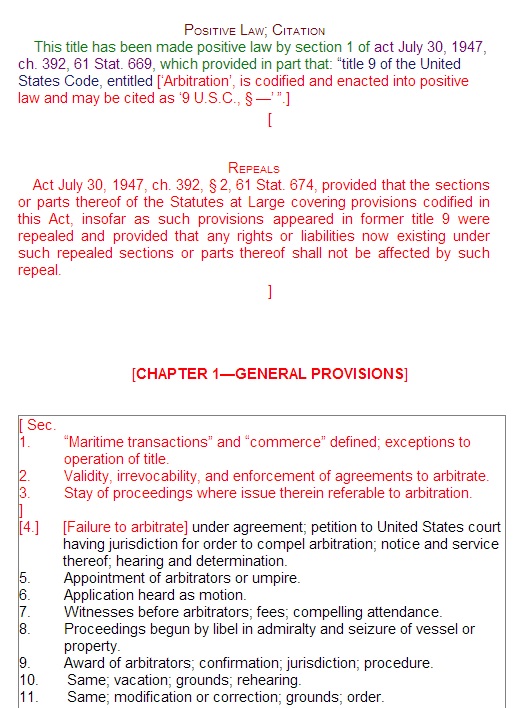
Redlining Take a look at the totally contrived example on the left. It’s admittedly not a real example, it comes from my stress testing of the change tracking facilities. But look at what it does. The red text is a complex deletion that spans elements with little regard to the structure. In our editor, this was done with a single “delete” operation. Try and do this with XMetaL – it takes many operations and is a real struggle – even with change tracking turned off. In fact, even Microsoft Word’s handling of this is less than satisfactory, especially in more recent versions. Behind the scenes, the editor is using the model, derived from the schema, to control this deletion process to ensure that a valid document is the result.
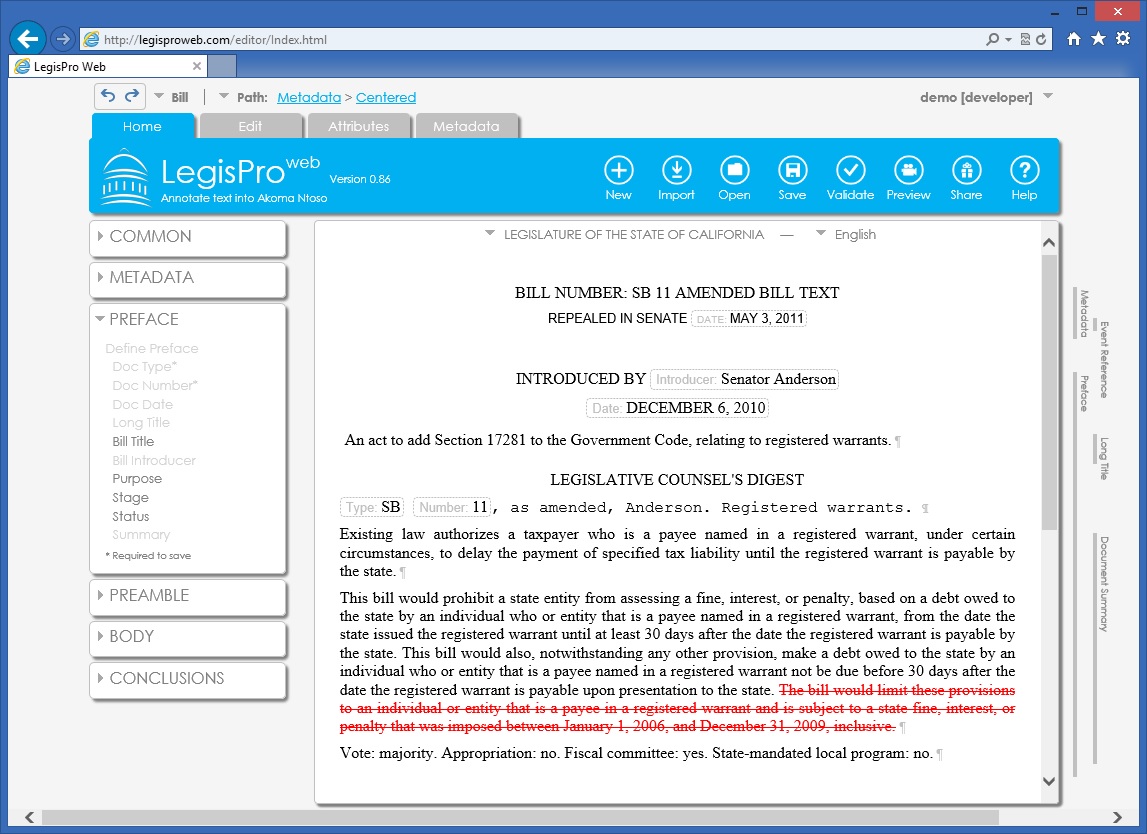
If you’re particularly familiar with XMetal, you will notice something else too. That deletion cuts through the structure of a table!!!! XMetaL can only track changes within the text of table cells, not the structure. We’re making great strides towards proper legislative redlining technologies, and we are excited to work with our partners and clients to put them into practice.

Standard
Akoma Ntoso, Standards, Transparency

The U.S. Code in Akoma Ntoso

I’m on my way to Italy this week for my annual pilgrimage to Ravenna, Italy and the LEX Summer School put on by the University of Bologna. This is my fourth trip to the class. I always find it so inspirational to be a part of the class and the activities that surround it. This year I will be talking about the many on-going projects that we have underway as well as talking, in depth, about the HTML5 editor I built for Akoma Ntoso.

Before I get to Italy, I wanted to share something I’ve been working on. It should come as absolutely no surprise to anyone that I’ve been working on producing a version of the U.S. Code in Akoma Ntoso. A few weeks ago, the U.S. Office of the Law Revision Counsel released the full U.S. Code in XML. My company, Xcential, helped them to produce that release. Now I’ve taken the obvious next step and begun work on a transform to convert that XML into Akoma Ntoso – the format currently being standardized by the OASIS Legal Document ML technical committee. I am an active member of that TC.

U.S. Code

About 18 months ago, I learned of a version of the U.S. Code that had been made available in XML. While that XML release was quite far from complete, I used to to produce a representation in Akoma Ntoso as it stood back then. My latest effort is a replacement and update of that work. The new version of XML released by the OLRC is far more accurate and complete and is a better basis for the transform than earlier release was. And besides, I have a far better understanding of the new version – having had a role in its development.

My work is still very much a work-in-progress. I believe in openly sharing my work in the hope of inspiring other to dive into this subject – so I’m releasing a partial first step in order to get some feedback. Please note that this work is a personal effort – it is not a part of our work with the OLRC. At this point I’ve written a transform to produce Akoma Ntoso XML according to the most recent schema released a few weeks ago. The transform is not finished, but it gives a pretty good rendition of the U.S. Code in Akoma Ntoso. I’m using the transform as a vehicle to identify use cases and issues which I can bring up with the OASIS TC at our weekly meetings. As a result, there are a few open issues and the resulting XML does not fully validate.

I’m making 8 Titles available now. They’re smaller Titles which are easier for me to work with as I refine the transform. Actually, I do have the first 25 Titles converted into Akoma Ntoso, but I’ll need to address some performance and space issues with my tired old development server before I can release the full set. Hopefully, over the next few months, I’ll be able to complete this work.

When you look at the XML, you will notice a “proposed” namespace prefix. This simply shows proposed aspects of Akoma Ntoso that are not yet adopted. Keep in mind that this is all development work – do not assume that the transformation I am showing is the final end result.

I’m looking for feedback. Monica, Fabio, Veronique, and anyone else – if you see anything I got wrong or could model better, please let me know. If anyone finds the way I modeled something troubling, please let me know. I’m doing this work to open up a conversation. By trying Akoma Ntoso out in different usage scenarios, we can only make it better.

Don’t forget the Library of Congress’ Legislative Data Challenge. Perhaps my transformation of the U.S. Code can inspire someone to participate in the challenge.

Standard
Akoma Ntoso, Hackathon, HTML5, LegisPro Web, Standards, Transparency, W3C

Web-Based XML Legislative Editor Update

It’s been quite a while since I gave an update on our web-based XML legislative editor – LegisProweb. But that doesn’t mean that nothing has been going on. Quite the contrary, this has been a busy year for the editor project.

Let me first recap what the editor is. It’s an XML editor, written entirely around HTML5 technologies. It was first developed last year as the centerpiece to a Hackathon that Ari Hershowitz and I staged in San Francisco and around the world. While it is designed as a general purpose XML editor and can be configured to model any XML schema, it’s primarily configured to support Akoma Ntoso.

LegisProWeb

Since then, there has been a lot of continuing interest in the editor. If you attended the 2013 Legislative Data and Transparency Conference this past May in Washington DC, you may have noticed Jim Harper of the Cato Institute demonstrating their “Deepbills” project. The editor you saw is a heavily customized early version of LegisProweb, reconfigured to handle the XML format that the US Congress publishes legislation in.

And that’s not the only place where LegisProweb has been adopted. We’re in the finishing stages of a somewhat larger implementation we did for Chile. This is an Akoma Ntoso implementation – focused on debates and debate reports rather than on legislation. One interesting point worth noting – this implementation is done in Spanish. LegisProweb is quite easily localized.

The common thread between these two implementations in the use case – they’re both implementations focused on tagging metadata within pre-existing documents rather than on creating new documents from scratch. This was the focus of the Hackathon we staged back in 2012 – little did we know how much of a market would exist for an editor focused on annotation rather than document creation. And there’s more to still come – we’ve been quite surprised in the level of interest in this particular use-case.

Of course, we’re not satisfied with an editor that can only annotate existing documents. We’ve been hard at work turning the editor into a full-featured legislative editor that works equally well at creating new documents as it does at annotating existing documents. In addition, we’ve made the editor very customizalble as well as adding capabilities to manage the comments and discussions that might revolve around a document as it is being created and annotated.

Most recently, the editor has been upgraded to the latest version of Akoma Ntoso coming out of the OASIS legal document ML technical committee where I am an active member. Along with that effort, the validator has been separated to run as a standalone Akoma Ntoso validator. I talked about that in my blog last week. I’m busy using the validator as I work frantically to complete an Akoma Ntoso project I am working on this week. I’ll talk some more about this project next week.

So where do we go from here? Well, the first big effort is to modularize the technologies found within the editor. We now have a diverse set of customers right now and they can all benefit from the various bits and pieces that make up LegisProweb. By modularizing the pieces, we’ll be able to pick and choose which parts we use when and how. Separating out the validator was the first step. We’ll also be pulling out the reference resolver, attaching it to a native XML database, and partitioning out the client-side to allow the editing component to be used without the full editing environment offered by LegisProweb.

One challenge that remains is handling redlining – managing insertions and deletions. This is a very difficult subject – and one I tackled in the work I did implementing the XML editor used by the California legislature. I took a very different approach in trying to solve the problem with LegisProweb, but I’m not happy with the result. So, I’ll be returning to the proven approach we used way back when we built the original LegisPro editor on XMetaL.

As you can tell, we’ve got our work for the next year cut out for us.

Standard
Akoma Ntoso, LegisPro Web, Standards, Transparency, W3C

Free Akoma Ntoso Validator

How are people doing with the Library of Congress’ Akoma Ntoso Challenge? Hopefully, you’re making good progress, having fun doing it, and in so doing, learning a valuable new skill with this important emerging technology.

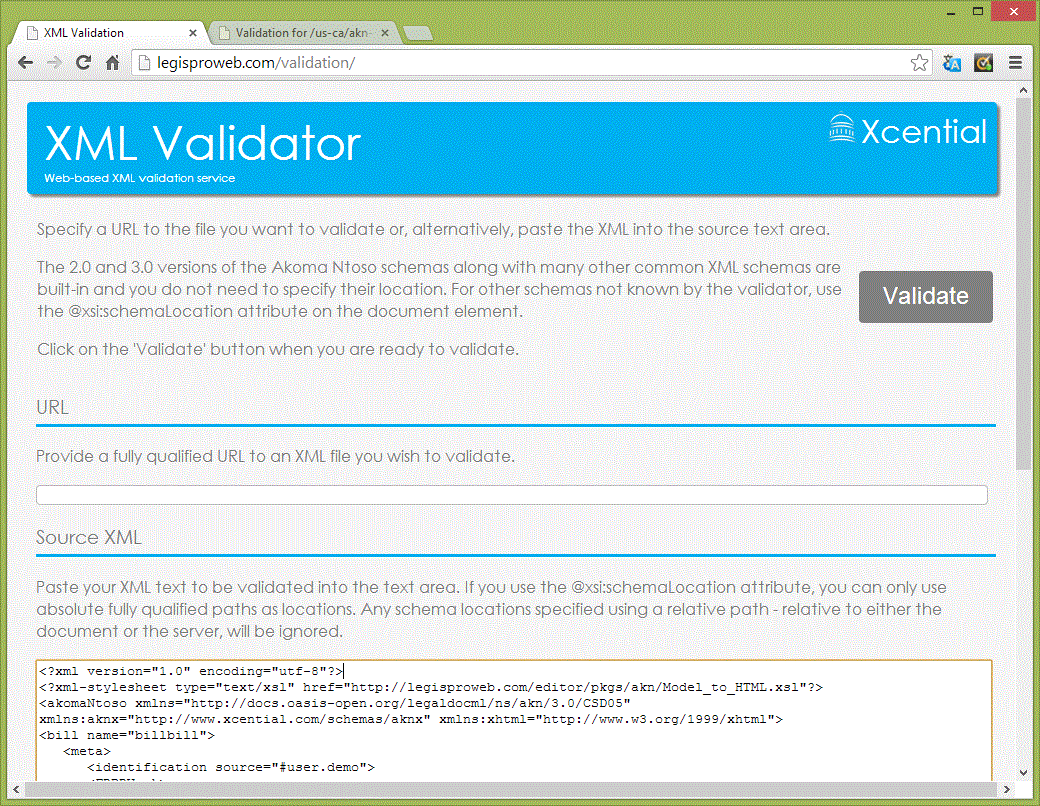
I decided to make it easy for someone without an XML Editor to validate their Akoma Ntoso documents for free. We all know how expensive XML Editors tend to be. If you’re like me, you’ve used up all the free trials you could get. I’ve separated the validation part of our LegisProweb editor from the editing base to allow it to be used as a standalone validator. Now, all you need to do is either provide a URL to your document or, even easier, drop the text into the text area provided and then click on the “Validate” button. You don’t even need to go find a copy of the Akoma Ntoso schema or figure out how to hook it up to your document – I do all that for you.

To use the validator, simply draft your Akoma Ntoso XML document, specifying the appropriate namespace using the @xmlns namespace declaration, and then paste a copy into the validator. I’ll go and find the schema and then validate your document for you. The validation results will be shown to you conveniently inline within your XML source to help you in making fixes. Don’t worry, we don’t record anything when you use the validator – it’s completely anonymous and we keep no record of your document.

You can validate either the 2.0 version of Akoma Ntoso or the latest 3.0 version which reflects the work of the OASIS LegalDocumentML committee. Actually, there are quite a few other formats that the validator also will work with innately and, by using xsi:schemaLocation, you can point to any XML schema you wish.

Give the free Akoma Ntoso XML Validator a try. You can access it here. Please send me any feedback you might have.

Validator1Input Form Validator2Validation Results
Standard
Transparency

U.S. House of Representatives release the U.S. Code in XML.

This week marked a big milestone for us. The U.S. House of Representatives released the U.S. Code in XML. You can see the announcement by the Speaker of the House, John Boehner (R-Ohio), here. This is a big step forward towards a more transparent Congress. As many of you know, my company, Xcential, has worked closely with the Law Revision Counsel on this project. It has been an honor to provide our expertise as part of our on-going efforts with the U.S. House of Representatives.

This project has been a great opportunity for us to update the U.S. House of Representatives technology platform by introducing new XML schema techniques along with robust and high performance conversion tools. Our eleven years in this field, working on an international scale, has given us valuable insights into XML techniques which we were able to bring to bear to ensure that success of this project.

The feedback has been very good:

As you can expect, members of the technical community have swiftly picked up on this release and are actively finding ways to use the data it provides. Josh Tauberer of GovTrack.us has already started – check out his work here. Why did I already know he would be the first to jump in. 🙂

Of course, if you know me, you’ll know that I also have something up my sleeve. I’ll be spending my weekends and evenings for the next few weeks to release an Akoma Ntoso transform coincident with an upcoming OASIS LegalDocML announcement. Keep watching my blog for more info.

This project has been one of numerous projects we are working on right now. We have a very similar project underway in Asia and an Akoma Ntoso project nearing completion using our HTML5-based editor, LegisProWeb, in South America. I’ll be providing an update on LegisProweb in the coming weeks.

Standard
Akoma Ntoso, LegisPro Web, Standards, Transparency

Akoma Ntoso Challenge by the Library of Congress

As many of you may have already read, the U.S. Library of Congress has announced a data challenge using Akoma Ntoso. The challenge lasts for three months and offers a $5,000 prize to the winner.

In this challenge, participants are asked to mark up four Congressional bills, provided as raw text, into Akoma Ntoso.

If you have the time to participate in this challenge and can fulfill all the eligibility rules, then I encourage you to step up to the challenge. This is a good opportunity to give Akoma Ntoso a try – to both learn the new model and to help us to identify any changes or adaptations that must be made to make Akoma Ntoso suitable for use with Congressional legislation.

You are asked, as part of you submission, to identify gaps in Akoma Ntoso’s design along with documenting the methodology you used to construct your solution to the four bills. You’re also encouraged to use any of the available open-source editors that are currently available for editing Akoma Ntoso and to provide feedback on their suitability to the task.

I would like to point out that I also provide an Akoma Ntoso editor at http://legisproweb.com. It is free to use on the web along with full access to all the information you need to customize the editor. However, while our customers do get an unrestricted internal license to the source code, our product is not open source. At the end of the day, I must still make a living. Nonetheless, I believe that you can use any editor you wish to create your four Akoma Ntoso documents – it’s just that the sponsors of the competition aren’t looking for feedback on commercial tools. If you do choose to use my editor, I’ll be there to provide any support you might need in terms of features and bug fixes to help speed you on your way.

Standard
Process, Transparency

Transparent legislation should be easy to read

Legislation is difficult to read and understand. So difficult that it largely goes unread. This is something I learned when I first started building bill drafting systems over a decade ago. It was quite a let down. The people you would expect to read legislation don’t actually do that. Instead they must rely on analyses, sometimes biased, performed by others that omits many of the nuances found within the legislation itself.

Much of the problem is how legislation is written. Legislation is often written so as to concisely describe a set of changes to be made to existing law. The result is a document that is written to be executed by a law compilation team deep within the government rather than understood by law makers or the general public. This article, by Robert Potts, rather nicely sums up the problem.

Note: There is a technical error in the article by Robert Potts. The author states “These statutes are law, but since Congress has not written them directly to the Code, they are added to the Code as ‘notes,’ which are not law. So even when there is a positive law Title, because Congress has screwed it up, amendments must still be written to individual statutes.” This is not accurate. Statutory notes are law. This is explained in Part IV (E) of the DETAILED GUIDE TO THE CODE CONTENT AND FEATURES.

So how can legislation be made more readable and hence more transparent? The change must come in how amendments are written – with an intent to communicate the changes rather than just to describe them. Let’s start by looking at a few different ways that amendments can be written:

1) Cut-and-Bite Amendments

Many jurisdiction around the world use the cut-and-bite approach to amending, also known as amendments by reference. This includes Congress here in the U.S., but it is also common to most of the other jurisdictions I work with. Let’s take a look at a hypothetical cut-and-bite amendment:

SECTION 1. Section 1234 of the Labor Code is amended by repealing “$7.50” and substituting “$8.50”.

There is no context to this amendment. In order to understand this amendment, someone is going to have to go look up Section 1234 of the Labor Code and manually make apply the change to see what it is all about. While this contrived example is simple, it already involves a fair amount of work. When you extrapolate this problem to a real bill and the sometimes convoluted state of the law, the effort to understand a piece of legislation quickly becomes mind-boggling. For a real bill, few people are going to have either the time or the resources to adequately research all the amendments to truly understand how they will affect the law.

2) Amendments Set Out in Full

I’ve come to appreciate the way the California Legislature handles this problem. The cut-and-bite style of amending, as described above, is simply disallowed. Instead, all amendments must be set out in full – by re-enacting the section in full as amended. This is mandated by Article 4, section 9 of the California Constitution. What this means is that the amendment above must instead be written as:

Section 1. Section 1234 of the Labor Code is amended to read:

1234. Notwithstanding any other provision of this part, the minimum wage for all industries shall be not less than $8.50 per hour.

This is somewhat better. Now we can see that we’re affecting the minimum wage – we have the context. The wording of the section, as amended, is set out in full. It’s clear and much more transparent.

However, it’s still not perfect. While we can see how the amended law will read when enacted, we don’t actually know what changed. Actually, in California, if you paid attention to the bill redlining through its various stages, you could have tracked the changes through the various versions to arrive at the net effect of the amendment. (See note on redlining) Unfortunately, the redlining rules are a bit convoluted and not nearly as apparent as they might seem to be – they’re misleading to the uninitiated. What’s more, the resulting statute at the end of the process has no redlining so the effect of the change is totally hidden in the enacted result.

Setting out amendments in full has been adopted by many states in addition to California. It is both more transparent and greatly eases the codification process. The codification process becomes simple because the new sections, set out in full, are essentially prefabricated blocks awaiting insertion into the law at enactment time. Any problems which may result from conflicting amendments are, by necessity, resolved earlier rather than later. (although this does bring along its own challenges)

3) Amendments in Context

There is an even better approach – which is adopted to varying degrees by a few legislatures. It is to build on the approach of setting out sections in full, but adds a visible indication of what has changed using strike and insert notation. I’ll refer to this as Amendments in Context.

This problem is partially addressed, at the federal level, by the Ramseyer Rule which requires that a separate document be published which essentially does shows all amendments in context. The problem is that this second document isn’t generally available – and it’s yet another separate document.

Why not just write the legislation showing the amendments in context to begin with? I can think of no reason other than tradition why the law, as proposed and enacted, shouldn’t show all amendments in context. Let’s take a look at this approach:

Section 1. Section 1234 of the Labor Code is amended to read:

1234. Notwithstanding any other provision of this part, the minimum wage for all industries shall be not less than $7.50 $8.50 per hour.

Isn’t this much clearer? At a glance we can see that the minimum wage is being raised a dollar. It’s obvious – and much more transparent.

At Xcential, we address this problem in California by providing an amendments in context view for all state legislation within our LegisWeb bill tracking service. We call this feature As Amends the LawTM and it is computed on-the-fly.

Governments are spending a lot of time, energy, and money on legislative transparency. The progress we see today is in making the data more accessible to computer analysis. Amendments in context would make the legislation not only more accessible to computer analysis – but also more readable and understandable to people.

Redlining Note: If redlining is a new term to you, it is similar to, but subtly different, to track changes in a word processor.

Standard